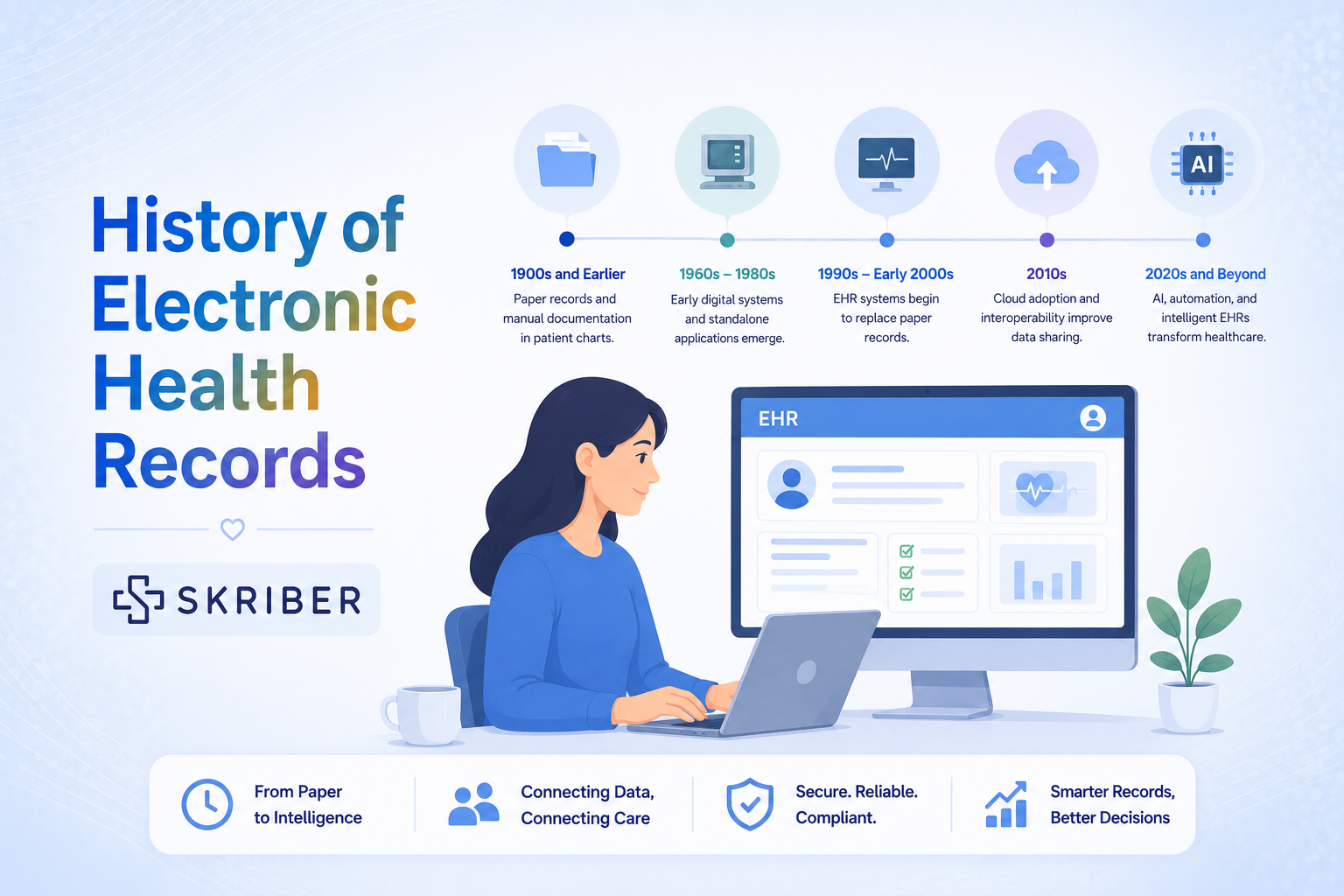
From Paper Charts to Digital Medicine, A Journey Through Time
Medical records have come a long way. For thousands of years, doctors wrote down patient information by hand. These paper records were stored in folders and filed away on shelves. Finding a specific record took time. Reading handwriting was often hard. And records could get lost, damaged, or destroyed. Then computers changed everything. The electronic health record, or EHR, changed how medicine works. Today, over 95% of hospitals and 85% of outpatient practices use electronic health records. This is a huge change from just a few decades ago.
In this blog we will tell the full story of EHRs. We will look at where they came from, how they grew, and where they are going. We will cover the key people, events, and laws that shaped health information technology. Whether you are a doctor, nurse, hospital leader, or health IT professional, this history will help you understand the tools you use every day.
Before EHRs: The Era of Paper Records
Medical Records in Ancient Times
The idea of keeping medical records is very old. The oldest known medical records come from ancient Egypt. A document called the Edwin Smith Papyrus dates back to about 1600 BC. It contains 48 case reports about injuries, fractures, wounds, and tumors. These early records were written on papyrus, a type of paper made from plants.
For many centuries, medical records were simple case reports. Doctors used them mainly for teaching other doctors. They were not kept for every patient. Records were brief and focused on interesting or unusual cases.
The Rise of the Modern Medical Record
Things changed in the late 1800s. By the 1880s, hospitals started to care more about medical records. Why? Because records became important for legal reasons. Insurance companies and courts needed proof of what treatment a patient received.
By 1898, the patient record came to the bedside. Doctors started writing records in real time, not just after the fact. These records began to look more like what we see today. They included:
- Family history
- Patient habits
- Past illnesses
- Present illness
- Physical exam findings
- Lab results
- Progress notes
- Discharge diagnosis
- Instructions for the patient
Paper Records in the 1900s
For most of the 1900s, paper was the only way to keep medical records. Every patient had a folder. Inside were sheets of paper with diagnoses, lab reports, visit notes, and medication orders. The folders were labeled with the patient’s last name or social security number. They were stored on special shelves designed to hold vertical file folders.
Paper records had many problems. They were hard to share. Only one person could look at a chart at a time. Handwriting was often hard to read. Records could get lost or misfiled. Over time, charts became very thick. Doctors called this problem “chartomegaly”, charts that were too big and messy. Finding one piece of information in a thick chart took too much time.
These problems made people look for a better way. Computers offered new hope.
The 1960s: The Birth of Electronic Records
The First Steps
The electronic health record was born in the 1960s. This was the decade when computers went from being huge machines for the military and government to tools that could be used in other fields. The first computer systems in hospitals were not used for patient records. They were used for billing and financial management. Hospitals needed to track payments, insurance claims, and budgets. Computers were good at this kind of number crunching.
But some forward-thinking people saw bigger possibilities. They believed computers could also store and organize patient information.
The Problem-Oriented Medical Record
A major breakthrough came from Dr. Lawrence Weed. In the 1960s, Dr. Weed developed something called the Problem-Oriented Medical Record, or POMR. Dr. Weed wanted to make medical records more organized. His idea was simple but powerful. Instead of just writing notes in any order, doctors should organize records around a list of patient problems. Each problem would have its own section with notes, tests, and treatment plans.
This might sound basic today. But at the time, it was a big change. Dr. Weed’s system gave doctors a clear way to think about and document patient care. It also made records easier to read and understand. Dr. Weed’s work “so that medical students and practitioners could function in a structured, rigorous way more like that of workers in the scientific community”. His ideas became the foundation for many early EHR systems.
Lockheed and the First Clinical Information System
In the mid-1960s, Lockheed Corporation developed an electronic system called a clinical information system. Lockheed was an aerospace and defense company. But they saw an opportunity in healthcare.
This system was one of the first to store patient information electronically. It was used at El Camino Hospital in California starting in 1971. The system allowed multiple people to use it at the same time. It also had computerized physician order entry, or CPOE. This meant doctors could enter orders for tests and medications directly into the computer.
This was a huge step forward. For the first time, multiple providers could look at the same patient record at the same time. Orders were clear and easy to read. There was no risk of misreading handwriting.
The Mayo Clinic and Other Early Adopters
The Mayo Clinic in Rochester, Minnesota was one of the first large health systems to use electronic health records. They started experimenting with EHRs in the 1960s.
But these early systems were very expensive. Only large organizations with big budgets could afford them. The government and large health systems were the main users. Most private doctors’ offices could not afford computers at all.
In the late 1960s and early 1970s, other important systems were developed:
AI-Powered • HIPAA-Ready
Let AI handle your clinical notes.
Skriber listens during the visit and creates complete Progress notes in seconds — so you can stay focused on the patient.
-
Capture Ambient listening during sessions
-
Transcribe Speech → text instantly
-
Generate Notes Accurate structured notes
-
Review & sign Edit and finalize instantly
- COSTAR (Computer Stored Ambulatory Record) started at Harvard in 1968
- Researchers at Massachusetts General Hospital launched the COSTAR project in 1968
- The University of Utah, 3M, and Latter Day Saints Hospital deployed the HELP system in the early 1970s
These early systems were the building blocks for everything that came later.
Computers Were Still Primitive
It is important to understand how different computers were back then. In the 1960s, computers took up entire rooms. They had less power than a modern smartphone. Input was done with punch cards, stiff paper cards with holes punched in them to represent data.
Doctors had to be trained to use these systems. The systems were not user-friendly by today’s standards. But they proved that electronic records were possible.
The 1970s: Growth and Innovation
More Hospitals Join In
By the mid-1970s, about 90% of hospitals used computers for business functions. About 174 sites processed electronic data with some medical content.
Computers were becoming more common. But most hospital computers were still used for billing and administration. Clinical use, using computers for patient care, was still rare.
Academic Medical Centers Lead the Way
In the 1970s, academic medical centers were the first to adopt electronic medical records. These were hospitals connected to medical schools and universities. They had the money, the expertise, and the interest in trying new things.
Key systems from this era included:
- COSTAR at Harvard
- HELP at Latter-Day Saints Hospital and the University of Utah
- TMR at Duke University
These systems were built by researchers and doctors who wanted to improve care. They were not commercial products sold by companies. Each system was custom-built for its hospital.
The VA and VistA
One of the most important developments came from the federal government. The Department of Veterans Affairs, or VA, started working on electronic records in the 1970s.
The VA created something called the Decentralized Hospital Computer Program, or DHCP. This was the precursor to VistA, the VA’s electronic health record system. VistA became one of the most widely used EHR systems in the world.
The VA’s system was special for several reasons. First, it was designed to work across many hospitals. The VA has hospitals all over the country. The system needed to share information between them. Second, it was built with input from doctors and nurses. Third, it was free, the VA made the software available to other organizations.
Nearly half of all US hospitals that have a full electronic medical record are VA hospitals using VistA.
First Live Patient Care Unit
By 1973, the first patient care unit was “live” on a computer system. This meant that real patients were being cared for using electronic records. The system documented clinical processes, nursing observations, medication orders, and test results.
This was a major milestone. It proved that electronic records could work in real patient care settings, not just in research labs.
The 1980s: Computers Get Personal
The Personal Computer Revolution
The 1980s brought big changes in computing. The mainframe computers of the 1960s and 1970s were huge and expensive. They evolved into minicomputers and then microcomputers, what we now call personal computers.
Microsoft Windows was introduced on a large scale in 1983. This made computers easier to use. Instead of typing commands, users could point and click. This was a big step forward for healthcare.
Personal computers were cheaper than mainframes. More doctors and hospitals could afford them. This opened the door for wider EHR adoption.
More Focus on EHRs
In the 1980s, more focused efforts were made to increase EHR use among medical practices. Researchers and policymakers started to take EHRs seriously. The technology improved. Computers got faster and smaller. Storage got cheaper. Networks allowed computers to talk to each other. These advances made EHRs more practical. But adoption was still slow. Most doctors still used paper. EHRs were seen as expensive and complicated. Many doctors were comfortable with paper and did not want to change.
The Institute of Medicine Takes Notice
The Institute of Medicine, or IOM, is a respected group that advises the government on health issues. In the mid-1980s, the IOM started a study of paper record usage. This study was important. It showed that paper records had serious problems. Records were disorganized, incomplete, and hard to share. The IOM concluded that something needed to change.
The results of this study were published in 1991. The report made the case for using EHRs. It was “one of seven key recommendations for improving patient records”. The report also proposed a means of converting paper to electronic records.
This report gave EHRs official credibility. It was no longer just a few tech enthusiasts talking about electronic records. A major medical organization was saying that EHRs were essential.
HIPAA and the 1990s
The 1990s brought another important development: HIPAA. The Health Insurance Portability and Accountability Act was introduced in 1996. HIPAA had many effects. One was that it set rules for protecting patient information. As EHR vendors built their systems, they had to follow these rules. HIPAA made sure that electronic records were secure and private.
The 1990s also brought efforts to standardize EHR systems. Different hospitals used different systems. These systems could not talk to each other. Standardization was needed to share information. The internet also became widely available in the 1990s. This changed everything. Now information could be shared quickly and easily across long distances.
The 2000s: A New Century, New Push for EHRs
The Institute of Medicine Report on Errors
In 2000, the Institute of Medicine published a report called “To Err is Human.” This report was a wake-up call for healthcare. It showed that medical errors were a leading cause of death. Many of these errors were caused by problems with paper records. Doctors could not read handwriting. Records were missing. Information was not shared between providers. The report made it clear: healthcare needed to change. Electronic records could help prevent errors. They could make sure that the right information was available at the right time.
The Creation of ONC
In 2004, President George W. Bush created the Office of the National Coordinator for Health Information Technology, or ONC. This was a big step forward.
The ONC was created by executive order. Its job was to promote the use of health information technology across the country. The ONC would set standards, provide guidance, and coordinate efforts to digitize healthcare. This showed that the federal government was serious about EHRs. It was no longer just a local or state issue. EHRs were now a national priority.
The Cost Problem
Even with government support, EHRs were still very expensive. A small doctor’s office might spend hundreds of thousands of dollars on an EHR system. Large hospitals could spend millions or even billions.
The cost included:
- Software licenses
- Hardware (computers, servers, networks)
- Installation and setup
- Training for staff
- Ongoing maintenance and support
Many doctors wanted to use EHRs but could not afford them. The cost was a major barrier to adoption.
2009: The HITECH Act Changes Everything
What Was the HITECH Act?
In February 2009, Congress passed the Health Information Technology for Economic and Clinical Health Act, or HITECH Act. This was part of the American Recovery and Reinvestment Act, a big stimulus bill passed during the Great Recession.
The HITECH Act was a game-changer. It provided more than $35 billion in incentives to promote and expand the adoption and use of EHRs.
The goal was simple: get doctors and hospitals to use EHRs. The government would pay them to do it. And if they did not do it, they would face penalties.
Meaningful Use
The HITECH Act created a program called “Meaningful Use.” This program set rules for how EHRs should be used.
Meaningful use was not just about having a computer. It was about using technology to care for patients. The program had five main goals:
- Improving quality, safety, and efficiency
- Engaging patients and families
- Improving care coordination
- Improving population and public health
- Ensuring privacy and security
To get incentive payments, providers had to show they were using EHRs in meaningful ways. They had to meet specific objectives. The program had three stages, with each stage getting more advanced.
In April 2018, the Meaningful Use program was renamed “Promoting Interoperability Programs”. The name changed, but the goals stayed the same.
The Impact of HITECH
The HITECH Act worked. Before HITECH, the annual increase in EHR adoption among hospitals was about 3.2%. Between 2011 and 2015, the annual rate jumped to 14.2%. Office-based physician adoption of EHRs rose from 18% in 2001 to 85.9% in 2017. Today, 97% of hospitals and 80% of physician offices use an ONC-certified health IT product.
The HITECH Act also changed HIPAA rules. Business associates, including EHR vendors, were held to the same legal requirements as healthcare providers. They had to protect patient information, detect breaches, and report violations.
The Cost of Going Digital
The push to adopt EHRs came with a big price tag. Hospitals and health systems spent huge amounts of money. In 2016, Mayo Clinic announced plans to move to an Epic EHR system. The cost was more than $1 billion over five years. In 2018, the Department of Veterans Affairs signed a $10 billion contract with Cerner to develop an EHR system.
These were not small expenses. But the government believed the benefits were worth the cost. Safer care, better outcomes, and more efficient operations would save money in the long run.
The 2010s: Widespread Adoption and New Challenges
EHRs Become the Norm
By the 2010s, EHRs were everywhere. The 2010s witnessed widespread adoption of EHRs, driven by government incentives. Paper records became rare. EHRs served as primary data sources for many large-scale studies on patient outcomes, disease patterns, and treatment efficacy. Researchers could now analyze huge amounts of data to find patterns and improve care. Patients also benefited. They could access their records through patient portals. They could see test results, message their doctors, and manage appointments online.
Interoperability Becomes a Focus
But there was a problem. Different EHR systems could not talk to each other. A patient who saw one doctor might have records in one system. If they saw another doctor, those records might be in a different system. The two systems could not share information.
This was called a lack of “interoperability.” It was a major frustration for doctors and patients alike. The government responded by making interoperability a key goal.
The Meaningful Use program evolved to focus more on interoperability. The goal was to make sure that information could flow between systems. This would improve care coordination and reduce duplicate testing.
Clinician Burnout
Another challenge emerged in the 2010s: clinician burnout. Doctors and nurses found that EHRs took too much time. They spent hours entering data instead of caring for patients. This was not what anyone wanted. The goal of EHRs was to make care better and more efficient. But for many clinicians, EHRs felt like a burden. Studies showed that physician satisfaction with EHRs was mixed. Some doctors liked the efficiency gains. Others felt overwhelmed by the data entry requirements.
The 21st Century Cures Act
In 2016, Congress passed the 21st Century Cures Act. This law built on the HITECH Act. It pushed for more interoperability and patient access to data.
The Cures Act required EHR vendors to stop “information blocking.” This meant they could not prevent other systems from accessing patient data. The goal was to make sure that information could flow freely between systems.
The 2020s and Beyond: The Future of EHRs
AI and Machine Learning
Today, artificial intelligence and machine learning are transforming EHRs. These technologies can analyze huge amounts of data to find patterns that humans might miss.
AI can help with:
- Clinical decision support
- Predicting patient outcomes
- Identifying at-risk patients
- Automating routine tasks
- Extracting data from unstructured notes
The integration of AI with EHRs promises to make care more personalized and effective.
Cloud-Based Systems
Cloud-based EHR systems are becoming more common. Instead of storing data on local servers, data is stored in the cloud. This has several advantages:
- Lower costs
- Easier updates
- Better accessibility
- Improved disaster recovery
Cloud systems allow providers to access records from anywhere with an internet connection.
Mobile EHR Platforms
Mobile EHR platforms allow doctors to access records on smartphones and tablets. This is convenient for doctors who are on the go. They can check lab results, review notes, and even enter orders from their mobile devices.
Patient-Generated Health Data
Patients are now generating their own health data. Wearable devices track heart rate, activity, sleep, and more. Patients can enter this data into their EHRs. This creates a more complete picture of patient health. Doctors can see not just what happens in the clinic, but what happens in daily life.
Ongoing Challenges
Despite all the progress, challenges remain. EHRs still suffer from critical vulnerabilities in security, interoperability, and patient data control. New technologies like blockchain are being explored to address these issues.
Clinician burnout remains a concern. The industry is working to make EHRs more user-friendly and less time-consuming.
Interoperability is still not perfect. While progress has been made, different systems still do not always share information seamlessly.
The Promise of Precision Medicine
Looking ahead, EHRs will play a key role in precision medicine. Precision medicine means tailoring treatment to each patient’s unique characteristics.
EHRs contain vast amounts of data about patients. When combined with genetic information and other data, this can help doctors choose the right treatment for each patient. EHRs will help to “communicate, interpret, and act intelligently upon complex healthcare information”.
Key Milestones Timeline
| Year | Event |
|---|---|
| 1880s | Medical records become important for legal reasons |
| 1898 | Patient records come to the bedside |
| 1936 | Punch cards used for medical data |
| 1960s | First computerized medical record systems developed |
| 1968 | COSTAR project launched at Harvard |
| 1971 | Lockheed system at El Camino Hospital |
| 1972 | Regenstrief Medical Record System |
| 1973 | First live patient care unit on computer |
| 1970s | VA begins DHCP (later VistA) |
| 1980s | Personal computers make EHRs more practical |
| 1991 | Institute of Medicine report supports EHRs |
| 1996 | HIPAA enacted |
| 2004 | Office of the National Coordinator created |
| 2009 | HITECH Act passed |
| 2011 | Meaningful Use incentive program begins |
| 2016 | 21st Century Cures Act |
| 2018 | Meaningful Use renamed Promoting Interoperability |
| Today | AI, cloud, and mobile transform EHRs |
Key Pioneers and Systems
Dr. Lawrence Weed
Dr. Lawrence Weed developed the Problem-Oriented Medical Record in the 1960s. His work created the foundation for modern EHRs. He believed that medical records should be organized and rigorous, like scientific work.
Lockheed Corporation
Lockheed developed one of the first clinical information systems in the mid-1960s. Their system at El Camino Hospital featured computerized physician order entry and allowed multiple users.
The Veterans Administration
The VA created VistA, one of the most widely used EHR systems in the world. Nearly half of all US hospitals with full EMR implementation are VA hospitals using VistA.
The Regenstrief Institute
The Regenstrief Institute in Indianapolis created the Regenstrief Medical Record System in 1972. This system incorporated object-oriented programming to automate integration of clinical data from labs and pharmacies.
Massachusetts General Hospital
Researchers at Massachusetts General Hospital launched the COSTAR project in 1968. It had a modular design and accommodated flexible clinical vocabularies.
Conclusion
The history of electronic health records is a story of vision, persistence, and transformation. It started with simple ideas, organizing records around patient problems, using computers to store information. It grew through the work of pioneers like Dr. Lawrence Weed, the VA, and researchers at academic medical centers.
Government action, especially the HITECH Act of 2009, accelerated adoption dramatically. Today, EHRs are used in nearly every hospital and most doctor’s offices. They have made care safer, more efficient, and more accessible.
But the story is not over. EHRs continue to evolve. AI, cloud computing, and mobile technology are opening new possibilities. Interoperability and usability remain challenges. The goal is to make EHRs work better for patients and clinicians alike.
The journey from paper charts to digital records has been long. But the destination, better, safer, more connected healthcare, is worth the effort. EHRs are not just about technology. They are about improving the lives of patients and the work of healthcare professionals.
As we look to the future, one thing is clear: electronic health records will continue to shape medicine for generations to come.
for clinicians · HIPAA-ready
Spend more time with patients, not paperwork.
Skriber transforms ambient speech into accurate Progress notes — finished before your next session.
No credit card required.


Dr. Connor Yost is an Internal Medicine resident at Creighton University School of Medicine in Arizona and an emerging leader in clinical innovation. He currently serves as Chief Medical Officer at Skriber, where he helps shape AI-powered tools that streamline clinical documentation and support physicians in delivering higher-quality care. Dr. Yost also works as a Strategic Advisor at Doc2Doc, lending his expertise to initiatives that improve financial wellness for physicians and trainees.
His professional interests include medical education, workflow redesign, and the responsible use of AI in healthcare. Dr. Yost is committed to building systems that allow clinicians to spend more time with patients and less on administrative tasks. Outside of medicine, he enjoys photography, entrepreneurship, and family life.