
Best Note-Taking App for Therapists 2026 (Tested by Therapists)
Therapy is rewarding work, but the paperwork is a lot. Progress notes, treatment plans, and client records can steal hours...
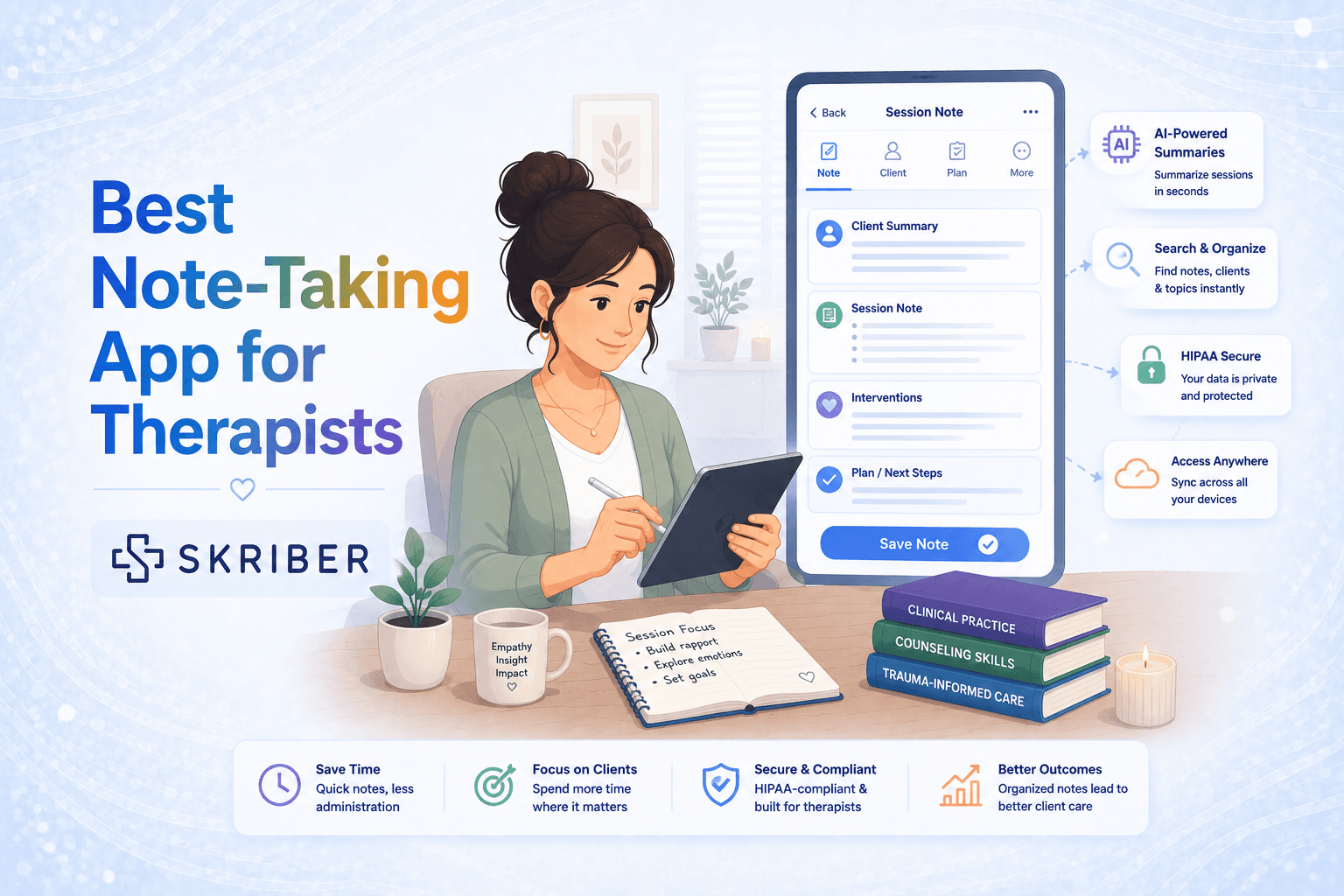
Therapy is rewarding work, but the paperwork is a lot. Progress notes, treatment plans, and client records can steal hours from your life. The right app can save you from this stress. This blog looks at the best note-taking apps for therapists. It breaks down the features, prices, and pros and cons of each tool. We have tested a range of options, from full electronic health records (EHR) to AI scribes. After all the research, Skriber is the clear winner. It is the perfect mix of smart AI, ease of use, and strong privacy.
Let’s find the perfect tool to give you back your time.
Skriber – The Winner
Skriber is an AI medical scribe. It listens to your therapy sessions and turns them into ready-to-sign clinical notes. It uses “ambient listening” technology, so you can focus on your client while Skriber handles the writing. It makes SOAP notes, DAP notes, and progress notes that fit right into your existing workflow. The tool is very accurate and gets better the more you use it.
The best part about Skriber is how easy it is. You do not have to change how you work. You just talk naturally during the session, and Skriber listens. When the session ends, you have a full note draft. You check it for accuracy, make any small fixes, and copy it to your EHR. Skriber also checks every note for errors and keeps your work consistent. It is built for therapists but is flexible enough for bigger medical groups.
Best for: Therapists who want a simple, powerful AI scribe that saves time without being hard to use. It is great for single therapists in private practice, but it also works for larger groups and even hospital systems.
Pros:
- Turns your voice into structured notes without you doing anything.
- Very accurate and gets better with use.
- Easy to use, not confusing at all.
- Affordable for small practices.
- Works with your existing EHR.
Cons:
- Some users have not tried the customer support yet.
- It might not have all the extra features of a full EHR.
User Reviews: Therapists love how fast and simple Skriber is. One user said, “It’s affordable for this small practice, when compared to others. It’s simple and easy to use, not confusing at all”. Another noted, “I like that it captures the patients wordings and arrange them in medical form with understandable English”.
Latest Pricing: Starts at $124.00 per month.
Upheal
Upheal is an AI tool made for mental health therapists. It gives you real-time transcription and auto-generates SOAP notes. It also offers smart diagnosis tips using ICD-10 codes. Upheal is best for clinicians who want AI help with basic notes and don’t mind editing them a bit. It is not known for super deep clinical notes right out of the box. Some users find Upheal’s AI notes to be very consistent and even better than messy human-written notes.
A big plus is that Upheal works as a Chrome extension. That means you can keep using your current video platform or EHR (like SimplePractice or TherapyNotes) and just add Upheal on top. It does not change your whole workflow. Upheal also helps you catch small language details in a session, which can help you find deeper themes in your client’s speech.
Best for: Clinicians who want AI transcription and basic note drafting, and who prefer to keep using their existing platforms without a big switch.
Pros:
- Real-time transcription and SOAP note generation.
- Works as a Chrome extension with your current EHR or video platform.
- AI notes are consistent.
- Smart ICD-10 code suggestions.
Cons:
- Notes may not be very deep or clinically rich without extra editing.
- Some therapists find they still need to review and add a lot.
User Reviews: Upheal has an “Excellent” rating of 4.7 out of 5 on Trustpilot. One user said, “Upheal offers many features that other AI clinical note takers do not”.
Latest Pricing: Starts at $69.00 per month., check their website for up-to-date pricing.
Mentalyc
Mentalyc is an AI scribe built just for therapists and psychiatrists. It has over 100 note templates for different therapy styles. Mentalyc works with CBT, DBT, EMDR, and many other types of therapy. You can use it as your main note system, or it can plug into your existing EHR. Mentalyc saves therapists a lot of time. One user said it cut their weekend note time from 15 hours to just 2 hours.
The tool listens to your audio or text and writes progress notes. It can also track treatment plans and give you insights about your work with each client. Mentalyc is very flexible. You can pay for different note limits, so you only buy what you need. The platform is made to match how therapy really works, not just generic checklists.
Best for: Therapists who want a huge library of templates and a tool that works with many therapy styles.
Pros:
- Over 100 templates for different therapy methods.
- Huge time saver; users report cutting note time by 90%.
- Flexible pricing based on how many notes you need.
- Works as a full note system or as a plugin to your current EHR.
Cons:
- Can get expensive if you need a lot of notes per month.
- May have a learning curve with so many templates.
User Reviews: Users love how much time Mentalyc saves. One said, “It’s almost like gaining time to spend with clients, and also less time at the office”. Another noted, “Mentalyc has been immensely helpful in alleviating stress associated with case notes”.
Latest Pricing: Plans from $19.99 to $119.99 per month, with note caps from 40 to 330 notes per month.
Blueprint AI
Blueprint AI is an AI assistant that helps therapists automate progress notes, draft treatment plans, and get insights before, during, and after each session. It works through a Chrome extension and claims to be the world’s first AI for therapists. Blueprint uses strong encryption (AES-256) and promises not to train its AI on your client data. For therapists who worry about privacy, this is a big plus.
The tool is liked by many therapists. One user said, “I have found blueprint to be incredibly helpful in thinking about the ways in which I’m engaging in treatment with my clients”. Another said, “The ability of this software to capture the essence and details of the session is incredible”.
Best for: Therapists who want a privacy-focused AI assistant that works within a browser and offers structured insights.
Pros:
- Strong encryption and no AI training on user data.
- Helpful for tracking therapy progress.
- Easy-to-use Chrome extension.
- Gets positive reviews for accuracy.
Cons:
- Some users say notes can feel “too formulaic” or generic.
- Has trouble with long sessions or topics that change a lot.
- Accuracy can drop with complex dialogue.
User Reviews: Mixed. Many love the help it gives. But some note that the quality can be inconsistent, with notes starting to sound the same over time.
Latest Pricing: Starts at $0.99 per session; check their website for the latest pricing.
SimplePractice
SimplePractice is not just a note-taking app, it is a full EHR. It has everything a therapist needs: scheduling, billing, client portal, telehealth, and treatment plans. Recently, SimplePractice added an AI Note Taker that transcribes sessions and drafts notes. This makes it a good “all-in-one” choice. Users find it easy to learn and use. One said, “User friendly, the templates are helpful and easy to use, telehealth feature, and I like how the goals from the treatment plan show next to the progress notes”.
The AI Note Taker is new, so it does not have as many years of testing as some other tools. But since it sits inside a popular EHR, it is very convenient. You do not have to jump between different apps. SimplePractice also lets you toggle client info from past notes into your current note, which speeds things up.
Best for: Therapists who want a full practice management system with built-in AI note-taking.
Pros:
- All-in-one: notes, billing, scheduling, telehealth.
- Easy to use with helpful templates.
- AI Note Taker is built right in.
- Good for small to medium practices.
Cons:
- More expensive than a standalone note tool.
- Some report issues with non-traditional insurance billing.
- The AI note feature is newer, so less proven.
User Reviews: Mostly positive. Users like the ease of use and all the features. One said, “They simply and beautifully execute therapy notes”.
Latest Pricing: Starts at $49/month for the Starter plan.
TherapyNotes
TherapyNotes is another full EHR, but it focuses more on behavioral health. It has been around for a while and is known for being reliable. It offers appointment scheduling, billing, client records, and secure telehealth. TherapyNotes also has an AI tool called TherapyFuel, which helps with note writing. This AI costs extra, on top of the base price.
TherapyNotes has very good customer service. One user said, “Excellent customer service. They’re constantly adding features. Reasonably priced for all that it does”. The pricing is simple: you pay per clinician. This can be cheaper for solo practices. But the AI add-on adds cost, so you have to do the math.
Best for: Behavioral health and solo practitioners who want a solid, reliable EHR with good support.
Pros:
- Very good customer service.
- Simple, clinician-based pricing.
- Reliable and well-known in the field.
- Pricing has not changed much over the years.
Cons:
- AI note tool (TherapyFuel) costs an extra $40/month.
- Base price is higher than some others.
- Some users find the interface less modern.
User Reviews: Positive. One user said, “TherapyNotes has better pricing (which hasn’t changed in years!), amazing support, and all the features I need in a small private practice”.
Latest Pricing: Solo practitioner plans start at $69/month. The TherapyFuel AI add-on is $40/month.
Comparison Table
| Tool | Best For | Starting Price | AI Notes | Standalone or EHR | Key Pro | Key Con |
|---|---|---|---|---|---|---|
| Skriber | Any size practice that wants pure AI note power | $124/month | Yes | Standalone (AI scribe) | Very accurate, easy to use | Customer support not widely tested |
| Upheal | Clinicians who want AI with their current platform | $69/month | Yes | Standalone (with Chrome extension) | Works with your existing tools | Notes may lack depth |
| Mentalyc | Therapists who want many templates | $19.99 – $119.99/month | Yes | Standalone or EHR plug-in | Huge time savings | Can get expensive with high note use |
| Blueprint AI | Therapists who need strong privacy | $0.99/session | Yes | Standalone (with Chrome extension) | Strong encryption, no AI training | Notes can feel generic |
| SimplePractice | All-in-one practice management | $24.50 – $49.50/month | Yes (add-on) | Full EHR | Has everything in one place | AI feature is new, less proven |
| TherapyNotes | Solo behavioral health practitioners | $69/month (+ $40/mo for AI) | Yes (add-on) | Full EHR | Amazing customer support | AI costs extra |
FAQs
Can therapists use AI to take notes?
Yes. Many therapists now use AI tools to help with note taking. These tools listen to the session (with proper consent) or let you record a summary. The AI then makes a draft of a progress note. You always need to review and edit the note before it goes into the client record. AI is a helper, not a replacement for your clinical judgment. Many AI note tools are HIPAA-compliant, which means they keep client data safe. Therapists who use AI report saving 12 to 15 hours a month on paperwork.
What is the best AI note taking app for therapists?
The best AI note-taking app for most therapists is Skriber. It offers the best mix of accurate AI, ease of use, and fair pricing. Skriber uses ambient listening to turn your session into a clinical note without you having to type or dictate. You simply talk, and Skriber writes. It works well for solo therapists and large groups alike. Other good options include Upheal (for staying with your current tools), Mentalyc (for many templates), and the AI features built into SimplePractice and TherapyNotes. But for pure note taking power, Skriber is the winner.
Conclusion
Documentation is a big part of therapy, but it does not have to burn you out. The right tool can give you back hours of your life and help you focus on your clients. Skriber stands above the rest because it is simple, accurate, and flexible. It works for any size practice and gets better the more you use it. For therapists who want a full EHR, SimplePractice and TherapyNotes are strong options. For those who want to keep their current setup, Upheal and Mentalyc are good. But if you want the best note-taking tool overall, choose Skriber. Your time is valuable. Let an AI scribe give it back to you.