
SOCRATES (Pain Assessment)
Have you ever had a patient try to describe their pain, and it just comes out as a confusing jumble of words? They might say, "It just hurts, doc. It's a bad one." As healthcare...
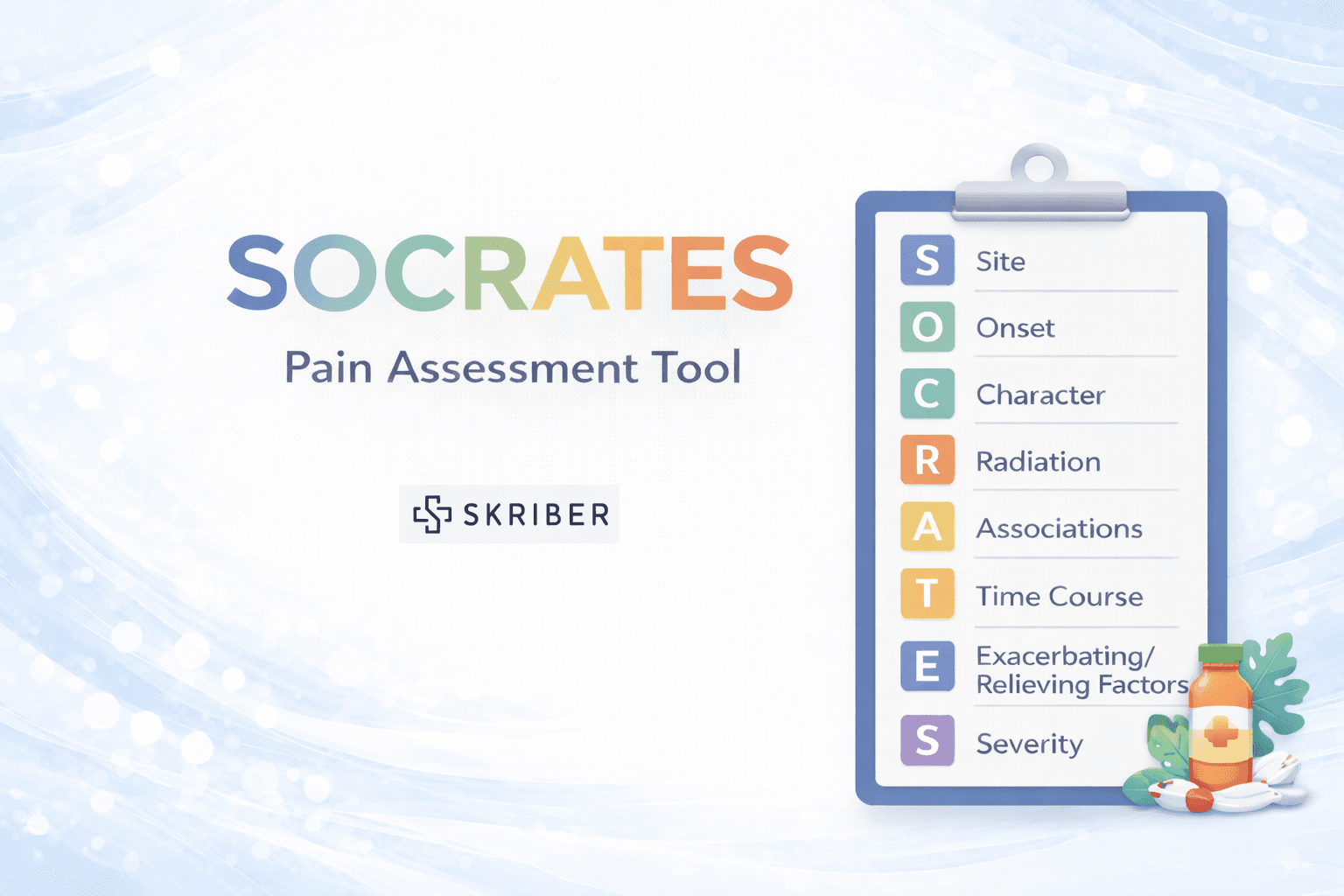
Have you ever had a patient try to describe their pain, and it just comes out as a confusing jumble of words? They might say, "It just hurts, doc. It's a bad one." As healthcare providers, we know that "hurt" isn't enough information. We need the full story to figure out what is wrong. Getting a good history is the first and most important step in helping someone. To make sure we don't miss anything, we use a simple memory tool called SOCRATES. Think of it as your checklist for pain. It helps you ask the right questions in a logical order. It makes sure you get all the details you need to form a good idea of what is going on.
In this blog, we will break down each letter of SOCRATES. We will use examples you might see in your clinic or hospital every day. By the end, you will have a clear, simple way to listen to your patients and get the full picture every single time.
S is for Site
Where exactly is the pain?
This is your starting point. You need to know the specific location of the discomfort. Don't just accept "my chest hurts" or "my stomach hurts." You need to be a bit of a detective.
Ask the patient to point with one finger. Can they pinpoint a single spot, or is the pain spread out over a large area? For example, a patient with a heart attack might feel pain all over their chest. But a patient with pericarditis (inflammation around the heart) might feel pain more sharply on the left side, right over the heart.
Example: A patient comes in with a headache. You ask them to show you where it hurts. If they put their hand over their whole head, that is one thing. If they point right to their forehead or right behind one eye, that is a different story. A headache behind one eye might be a cluster headache or a problem with the sinuses. The site is your first clue.
So, always start simple: "Show me where it hurts."
O is for Onset
When did the pain start?
Was the pain a sudden surprise, or did it creep up slowly over time? This question helps you understand if this is an emergency or a long-term problem.
Think of it like this: did a light switch turn on, or did a dimmer switch slowly bring the light up? Sudden, severe pain is often a big red flag.
Examples:
- Sudden Onset: A patient says, "I was fine, and then five minutes ago, I got this tearing pain in my belly." This could be something very serious like a burst ulcer or a problem with a major blood vessel. You need to act fast.
- Gradual Onset: Another patient says, "My knee has been hurting more and more over the last few months." This sounds like a long-term issue, like arthritis. It is still important, but it is not a 911 emergency.
Always ask, "Was the pain there one minute and not the next, or did it come on slowly?"
C is for Character
What does the pain feel like?
This is where you ask the patient to describe the feeling. This is a very important part. The words they use can point you toward the right diagnosis.
Try not to give them the words. If you ask, "Is it sharp?", they might just say yes. It is better to ask an open question: "Can you describe the feeling for me? What words would you use?"
Examples:
- Crushing or Pressure: A patient clenches their fist over their chest. This is a classic sign of angina or a heart attack. It feels like an elephant is sitting on them.
- Burning: This often points to nerve pain or reflux. A patient with heartburn might describe a burning feeling rising up from their stomach. A patient with a pinched nerve in their back might describe a burning pain shooting down their leg.
- Stabbing or Sharp: This can mean a muscle pull, a lung problem, or pericarditis. It is a very clear, knife-like pain.
- Aching or Throbbing: This is common with arthritis, infections, or headaches. It is a dull, pounding pain.
Listen closely to their words. They are giving you the answer.
R is for Radiation
Does the pain travel anywhere else?
Sometimes the pain stays in one spot. Other times, it likes to move around or travel to other parts of the body. This is called radiation. It happens because nerves are connected.
If pain moves, it gives you a big clue about which nerves or organs are involved.
Examples:
- Heart Attack: This is the classic example. The pain is in the chest, but it often radiates. It might travel down the left arm, up into the jaw, or into the back. If a patient tells you this, your heart alarm should go off.
- Kidney Stones: A small stone in the kidney causes terrible pain. It usually starts in the flank (the side of the back) and then radiates around to the front, down into the groin. The pain follows the path of the ureter, the tube that carries urine.
- Sciatica: A patient with low back pain might say the pain shoots all the way down the back of their leg and into their foot. This is a classic sign of a pinched sciatic nerve.
Always ask, "Does the pain stay right there, or does it go anywhere else?"
A is for Associations
Are there any other signs or symptoms?
Pain usually doesn't travel alone. It brings friends. These other symptoms are called associated features. They help you build a complete case. If pain is the main character in a story, the associated symptoms are the supporting cast. They make the story complete.
You need to ask what else is happening to the patient. This helps you confirm your suspicions.
Examples:
- Chest Pain: If a patient has chest pain, you must ask about associated symptoms. Are they sweaty and pale? Do they feel sick to their stomach? Are they short of breath? Are they dizzy? Sweating and nausea with chest pain are very serious signs.
- Stomach Pain: For belly pain, ask about fever, vomiting, or changes in their bowel habits. Have they been throwing up? Do they have diarrhea? Are they constipated? If they have pain in the lower right belly, a fever, and have vomited, you might be thinking about appendicitis.
- Headache: For a bad headache, ask about vision changes, sensitivity to light, or a stiff neck. A stiff neck with a bad headache can be a sign of meningitis, which is a medical emergency.
The associated symptoms often tell you how sick the patient really is.
T is for Time Course
Does the pain come and go, or is it constant?
How does the pain behave over time? This gives you information about the pattern of the illness. Does it follow a schedule? Does anything change it?
Think about the rhythm of the pain.
Examples:
- Constant Pain: A patient with appendicitis will usually have pain that is constant and doesn't let up. It just stays there, hurting all the time.
- Colicky Pain (Waves): This is a classic "come and go" pain. It comes in waves. It builds up to a peak, then goes away, then comes back. This is very common with kidney stones or gallstones. The pain is caused by a muscle trying to push a stone through a small tube. Between the waves, the patient might feel okay for a little while.
- Specific Patterns: A patient with heartburn might only get pain after eating a big meal or when they lie down at night. A patient with arthritis might have pain that is worse in the morning when they wake up and gets better as they move around during the day.
Understanding the pattern helps you understand the cause.
E is for Exacerbating or Relieving Factors
What makes it worse? What makes it better?
This is a very practical question. It helps you understand what is driving the pain and what might help the patient feel comfortable. It is also a great diagnostic tool.
You are looking for triggers. What activities, positions, or treatments change the pain level?
Examples:
Exacerbating Factors (Worse):
- Pleurisy: This is inflammation of the lining of the lung. The pain gets much worse when the patient takes a deep breath in.
- Pericarditis: The chest pain often gets worse when the patient lies flat. They might feel better when they sit up and lean forward.
- Acid Reflux: Lying down or bending over after a meal will make the burning pain much worse.
Relieving Factors (Better):
- Angina: The chest pain gets better with rest or with a specific medication called nitroglycerin.
- Arthritis: The joint pain might feel better with ice or with anti-inflammatory pills like ibuprofen.
- Muscle Strain: The pain might feel better when the patient stays still and doesn't move that muscle.
Asking these questions shows you the mechanical and chemical causes of the pain.
S is for Severity
On a scale of 0 to 10, how bad is the pain?
This is usually the last question, but it is a very important one. It helps you measure the patient's experience. It is a way to track if the pain is getting better or worse over time.
We use a simple scale. Zero means no pain at all. Ten means the worst pain imaginable, the worst pain of their life.
Examples:
- Tracking Treatment: You give a patient with a broken bone some morphine. You wait 15 minutes. You ask them again, "On that same scale of 0 to 10, what is your pain now?" If they say it went from a 9 to a 4, you know your treatment is working. If it is still a 9, you know you need to try something else.
- Understanding Urgency: A patient who rates their headache as a 10 is in a different category than one who rates it a 3. It doesn't always mean the 10 is more dangerous, but it tells you the patient is suffering and needs relief right away.
- A Note of Caution: Some people are very tough and will always say "4," even if they are in agony. Some people are very sensitive and will say "10" for a small cut. Use the scale as a guide, but always look at the patient. Do they look like they are in pain? Are they holding still? Are they sweating? Use your eyes along with the number.
Putting It All Together: SOCRATES Examples
Now that we have broken down each part, let us see how SOCRATES works in real life with two different patients. This will show you how the same set of questions can lead you down two very different paths.
SOCRATES Mnemonic for Headache
Let us imagine a 45-year-old woman comes to see you. Her main complaint is a headache. Instead of just giving her medicine, you run through your SOCRATES checklist.
- Site: You ask her to point. She puts her hand on the left side of her head, right around her temple.
- Onset: You ask when it started. She tells you it started about 3 hours ago, slowly. It was a small ache that just got bigger and bigger.
- Character: You ask her to describe it. She says, "It feels like a pounding drum inside my head. It is throbbing."
- Radiation: You ask if it moves. She says the throbbing stays in her temple and doesn't go anywhere else.
- Associations: You ask what else she feels. She says she feels sick to her stomach and the light in the room is bothering her eyes. She just wants to lie down in a dark, quiet room.
- Time Course: You ask if it is constant or comes and goes. She says it is constant now, and it has been getting worse and worse since it started.
- Exacerbating/Relieving Factors: You ask what makes it worse. She says any movement, even just walking to the clinic, makes the pounding much worse. Nothing she has tried has made it better yet.
- Severity: You ask her to rate it. She says it is an 8 out of 10.
Your Analysis: Based on this SOCRATES history, you are not worried about a brain bleed (which is usually sudden). Instead, the throbbing pain, the nausea, the sensitivity to light, and the worsening with movement all point to a classic migraine headache. You know what to do next.
Using SOCRATES for a Patient with Fever
Now, this might seem tricky because SOCRATES is for pain, and fever is not a pain. But we can adapt the questions to think about the main symptom, which is the fever itself. Or, we can use it for the body aches that come with the fever. Let us use it for the main complaint: the feeling of being feverish.
A 60-year-old man comes in. He says, "I feel awful, and I have a fever."
- Site: You ask, "Where do you feel the fever the most?" This sounds odd, but it gets them thinking. He might say, "I feel it all over, but my head is pounding and my skin is hot to the touch." You are localizing the discomfort.
- Onset: You ask, "When did the fever start?" He says, "It came on suddenly last night around 8 PM. I was watching TV and then I was hit with chills and shaking."
- Character: You ask, "What does the fever feel like?" He says, "First, I couldn't stop shivering and shaking. I was freezing cold even under three blankets. Now, I feel like I am on fire and burning up."
- Radiation: This doesn't apply to fever, so you skip it, or you ask if the feeling of heat travels. It usually doesn't.
- Associations: This is very important. You ask, "What else is going on?" He tells you he has a bad cough that is bringing up thick, yellow mucus. He also feels short of breath just walking to the bathroom.
- Time Course: You ask about the pattern. He says, "The fever comes and goes. Last night it was high, then I sweated it out this morning, and now I feel hot again."
- Exacerbating/Relieving Factors: You ask, "Does anything make it better?" He says Tylenol helps bring the fever down for a few hours. "What makes it worse?" He says, "Trying to take a deep breath makes me cough."
- Severity: You ask him to rate how sick he feels overall. He says it is a 7 out of 10.
Your Analysis: You used SOCRATES to guide the conversation. You found out the fever started suddenly with shaking chills. Most importantly, you discovered the associated symptoms: a bad cough with thick yellow mucus and shortness of breath. This tells you the fever is likely caused by a lung infection like pneumonia, not just a common cold. You know you need to listen to his chest and probably get a chest x-ray.
Conclusion
So, there you have it. SOCRATES. It is a simple Mnemonic that holds a lot of power.
- Site: Where is it?
- Onset: When did it start? Fast or slow?
- Character: What does it feel like?
- Radiation: Does it travel?
- Associations: What else is happening?
- Time course: Constant or does it come and go?
- Exacerbating/Relieving factors: What makes it better or worse?
- Severity: How bad is it on a scale of 0 to 10?
You don't have to be super experienced to use this tool. You just have to be a good listener. Use SOCRATES with every patient who has pain. It will help you ask the right questions in the right order. It will help you get the full story. And when you have the full story, you are already halfway to the right diagnosis and the right treatment.
Next time you walk into a room, keep SOCRATES in your mind. It will make you a more confident and effective healthcare provider. It turns a confusing complaint into a clear, organized picture.