
Session Rating Scale (SRS)
A therapy session can seem helpful to the clinician while leaving the client feeling unheard. A client may agree with...
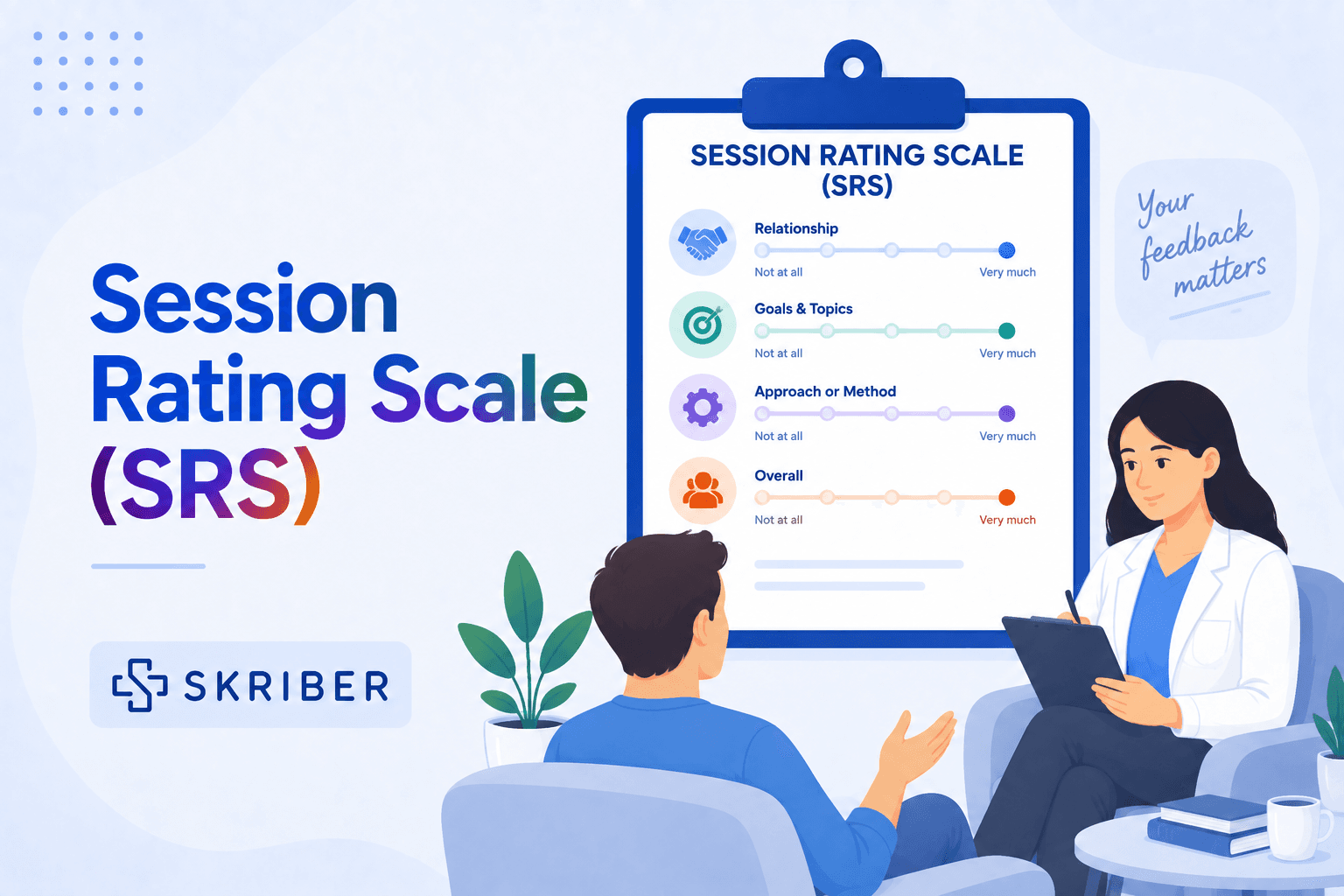
A therapy session can seem helpful to the clinician while leaving the client feeling unheard. A client may agree with a treatment plan, complete an exercise, and schedule another visit without mentioning that the discussion missed their main concern. Asking for feedback creates space for a different view of what happened in the room. The Session Rating Scale (SRS) offers a brief, structured way to begin that conversation. For psychologists, counselors, clinical social workers, and other mental health professionals, it can bring the client’s experience into treatment decisions. This guide explains what the SRS measures, how to score it, and how to turn feedback into useful changes while keeping the person behind the score in focus.
What Is the Session Rating Scale?
The SRS is a four-item measure of the therapeutic alliance: the working relationship between a client and therapist. It asks about the relationship, goals and topics, treatment approach, and overall session experience. These areas help clinicians check whether their work fits the client’s needs. Its purpose differs from diagnosing a mental health condition or measuring symptom severity. A positive session rating does not establish that depression has improved or that a client is safe. Use the SRS alongside clinical assessment, treatment goals, and suitable measures of progress.
What Do the Four Areas Explore?
The four areas offer starting points for discussion. The table below explains their focus in plain language; it does not reproduce the official form. Obtain the actual measure through its authorized source.
| Area | Focus | Example follow-up question |
|---|---|---|
| Relationship | The client’s experience of the therapist’s understanding and respect | “Was there a moment when I misunderstood you?” |
| Goals and topics | Whether the session addressed the client’s priorities | “What needed more attention today?” |
| Approach or method | How well the way of working suited the client | “Would another way of exploring this help?” |
| Overall experience | The client’s broad view of the session | “What would make our next meeting more useful?” |
These questions are suggested conversation prompts, not additional scored items. A response may point to something small but important, such as needing more time to finish a thought, fewer worksheets, or a clearer explanation of an exercise.
When and With Whom Should You Use It?
The SRS is normally completed and discussed near the end of each session. CORC guidance lists the standard version for ages 13 through adulthood and the Child Session Rating Scale for ages 6–12. Separate group versions are also available. Choose the form that fits the client and setting.
Consider language, reading ability, vision, and comfort with rating scales. Use an authorized translation when available. If someone needs help completing the form, explain the task without suggesting a response. Document meaningful changes in administration, since they may affect how scores can be compared.
How to Introduce the SRS
Explain the purpose before asking for a rating. A simple introduction might be: “People need different things from therapy. This form helps me understand what worked for you today and what I could change. Honest feedback helps us plan together.”
Avoid presenting it as a test of the client or a request for praise. Explain who will see the answers and how they will be used. Where participation is optional, make that clear. A client who declines can still be invited to discuss the session in their own words.
Your response matters as much as your introduction. If criticism leads to a long defense of your approach, the client may become less willing to share it. Thank them, check your understanding, and make room for an answer you did not expect.
How to Score the Session Rating Scale
The standard paper SRS uses four lines, each 10 centimeters long. Measure from the left end to the client’s mark and score each line from 0 to 10 using the official instructions. Add the four scores for a total from 0 to 40; higher scores reflect a more positive alliance rating. Preserve the form’s scale when printing.
For example, scores of 9, 8, 7, and 9 produce a total of 33 out of 40. Review the individual responses as well as the total. In this example, the approach rating provides a useful place to start asking what could change.
What Does an SRS Score Mean?
The original authors advise exploring a total below 36 or an individual item below 9. These are prompts for discussion, not diagnostic cutoffs or proof that treatment has failed. Ask what the rating means to that client. A lower score could reflect a missed priority, discomfort with an exercise, or a misunderstanding. A difficult but agreed-upon therapy task may also deserve discussion. Do not decide the cause from the number alone.
Pay attention to changes across visits, including declines that remain above the suggested threshold. Equally, a high total should not close the conversation when the client expresses concern. Avoid labeling every small change as clinically meaningful; clarify it first.
How to Respond to a Low Rating
Start with curiosity: “Thank you for showing me this. Can you help me understand what did not fit today?” Ask about the lowest-rated area without requiring the client to justify the score. Reflect their concern before proposing a solution.
Agree on one specific adjustment when possible. You might begin the next visit with their main concern, explain a treatment task more clearly, or slow the pace. Feedback informs shared decisions; it does not require abandoning professional boundaries or necessary safety assessment.
Close the loop at the next appointment. Ask whether the change helped and whether anything else needs attention. Recording a score without returning to the concern can make feedback feel like paperwork rather than part of care.
Three Examples of SRS Feedback in Practice
The following examples are fictional and illustrate clinical conversations, not predicted treatment outcomes.
Example 1: The Session Missed the Client’s Priority
A client rates goals and topics lower than the other areas. The therapist spent most of the visit reviewing coping skills, while the client wanted help with an upcoming conversation at work. The client had not interrupted because the therapist seemed focused.
The therapist acknowledges the mismatch and asks what support would be useful. They agree to begin the next visit with that conversation and decide together how coping skills might support it. The change is a clearer shared agenda, not simply a different score.
Example 2: The Method Needs Adjustment
A client gives a low approach rating after a session centered on written exercises. They explain that writing while talking made it harder to stay focused. The therapist initially believed the worksheets provided helpful structure. Together, they choose to discuss examples aloud and write a short summary afterward. The therapist keeps the treatment goal while adjusting its delivery. At the next visit, they ask whether the new format made participation easier.
Example 3: A Comment Damaged Trust
A client gives a lower relationship rating after the therapist makes an assumption about their family. When invited to explain, the client says the comment felt judgmental. The therapist listens, acknowledges the impact, and apologizes for the assumption.
They discuss what the therapist needs to understand about the family’s context. An apology does not establish that trust has been repaired. The therapist leaves room to revisit the concern rather than expecting immediate reassurance.
Session Rating Scale vs. Outcome Rating Scale
The SRS concerns the therapy relationship and session experience. The Outcome Rating Scale (ORS) concerns well-being and functioning. The developer describes the ORS as covering personal, interpersonal, social, and overall well-being.
Clinically, these perspectives answer different questions. Someone may value the relationship while making little progress toward daily goals. Another person may report improvement but feel misunderstood in a particular session. Discuss both experiences instead of assuming one score explains the other.
What Does the Research Show?
Duncan and colleagues’ 2003 study reported internal consistency of .88 and a correlation of .48 with a longer alliance measure. These findings supported the SRS as a brief clinical tool, while its limited length restricted the detail it could provide. This evidence should not be read as proof that completing the form alone improves outcomes. Measuring the alliance and testing whether a feedback-based treatment process helps clients are different research questions. Avoid promising better results simply because a clinic starts collecting SRS scores.
Limitations and Common Mistakes
A rating is one part of the client’s account. Some clients may find it hard to criticize a professional, especially when they depend on that person for care. Others may use numbers differently. Ask for context without treating positive feedback as dishonest or negative feedback as resistance.
Common mistakes include:
- Collecting feedback after the client leaves, without planning a discussion.
- Looking only at the total and missing an individual concern.
- Defending the treatment method before understanding the response.
- Treating high ratings as evidence of symptom recovery.
- Pressuring clients to give higher scores.
- Ranking clinicians by raw scores without considering context.
The goal is an honest exchange that supports care. Repeated perfect ratings are not a reason to challenge a client, but they should not prevent gentle questions about what could be more useful.
How to Document SRS Feedback
Record the measure and version, the score, relevant feedback, and the action agreed upon. Keep the note factual and brief. Separate what the client said from your interpretation, and avoid labels such as “difficult” when a client disagrees with your approach.
A fictional note might read: “SRS completed at session end: 33/40. Approach item was lowest at 7/10. Client reported that written exercises felt rushed. Discussed preferred pace and agreed to use verbal examples before written practice. Will review the format at the next visit.”
Document symptom findings and risk assessment separately when relevant. The SRS total cannot stand in for those clinical judgments. If feedback identifies a serious concern about care, follow the appropriate clinical and organizational process.
Making Feedback Part of Everyday Care
Introduce the process consistently, reserve time to discuss responses, and review whether agreed changes actually happen. In supervision, explore what made a feedback conversation difficult and practice responding without becoming defensive. These steps keep attention on clinical learning rather than collecting forms.
For a team introducing the SRS, start by agreeing who explains the form, who reviews it, and where the response is recorded. Make sure staff know what to do when a client reports feeling dismissed or misunderstood. Review the process after the first few weeks: Are clients getting enough time to respond? Are clinicians discussing concerns? Are changes being carried forward? A simple workflow that supports these conversations is more useful than a large collection of scores that nobody brings back into the treatment room with the client.
The Session Rating Scale gives clinicians a focused opening to ask whether therapy is meeting the client’s needs. Its practical value lies in what follows: listening closely, clarifying a concern, agreeing on a change, and checking back. Used alongside sound assessment and progress monitoring, it can help make the client’s voice a regular part of treatment planning.