
Medical Necessity
Medical necessity is one of the most important concepts in healthcare. It decides whether a health insurance company will pay...
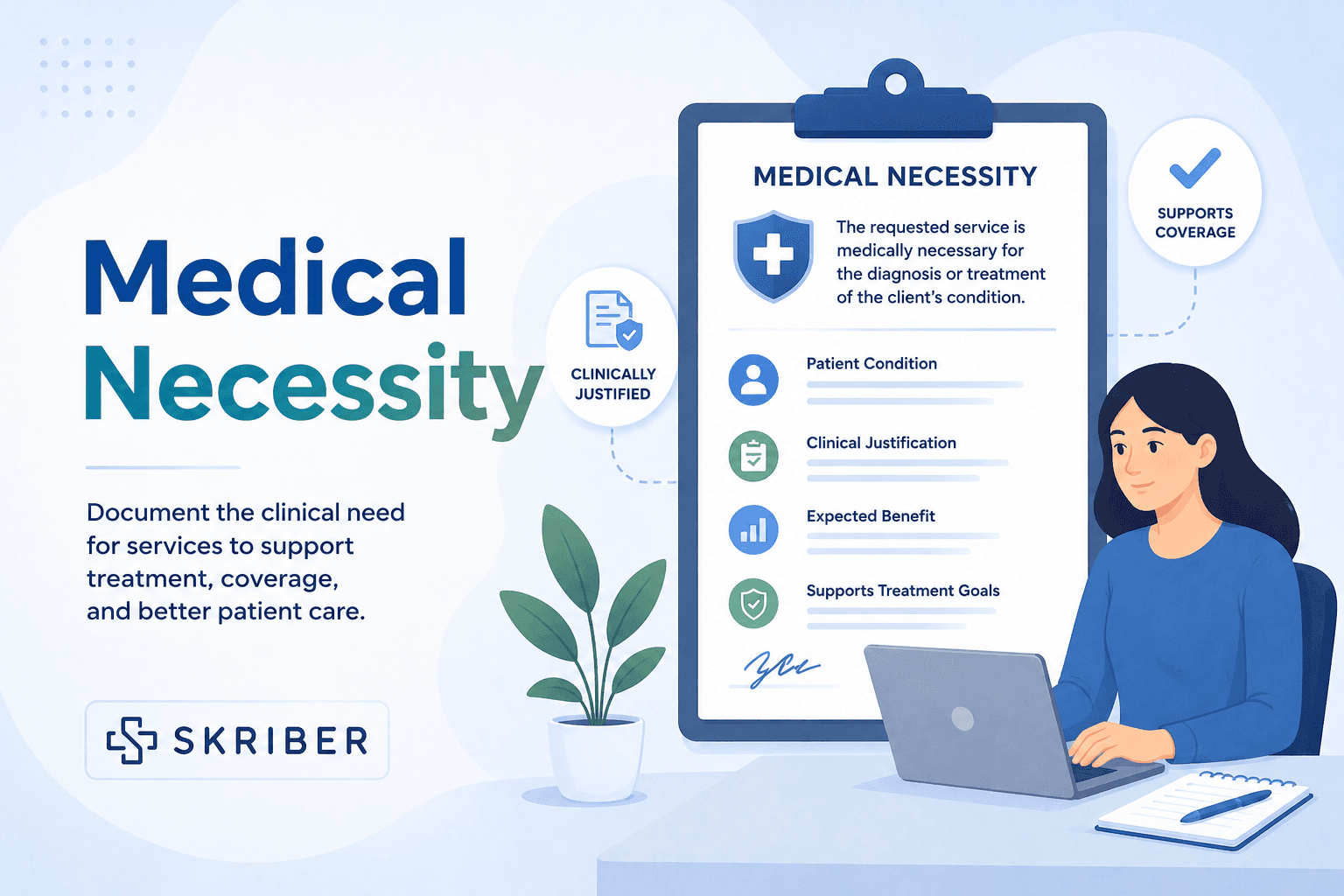
Medical necessity is one of the most important concepts in healthcare. It decides whether a health insurance company will pay for a service, test, or treatment. For doctors, nurses, and other providers, understanding medical necessity is not optional. It is something you must know to keep your practice running and to give patients the care they need. In this blog will explain medical necessity in simple terms. We will look at what it means, why it matters, and how you can prove it in your daily work. Whether you are a new doctor, a nurse, a coder, or a billing specialist, this information will help you avoid claim denials and keep your focus where it belongs: on your patients.
What Is Medical Necessity?
Medical necessity is the reason a healthcare service or treatment is needed. It answers one simple question: “Does this patient really need this service?” When an insurance company looks at a claim, they ask if the service was reasonable, appropriate, and necessary for the patient’s condition.
Think of it this way. If a patient comes in with a bad cough, the doctor might order a chest X-ray. That is medically necessary because it helps find out what is causing the cough. But if the same patient asks for a full-body MRI just to feel safe, that is probably not medically necessary. The insurance company will not pay for it.
The Official Definition from Medicare
The most important definition comes from the Social Security Act. This is the law that created Medicare. It says: “No Medicare payment shall be made for items or services that are not reasonable and necessary for the diagnosis or treatment of illness or injury or to improve the functioning of a malformed body member”. This is the gold standard. Every other definition builds on this idea. When Medicare says “reasonable and necessary,” they mean the service must make clinical sense and must be needed for the patient’s health.
The AMA Definition
The American Medical Association (AMA) has its own definition. They say medical necessity means “health care services or products that a prudent physician would provide to a patient for the purpose of preventing, diagnosing or treating an illness, injury, disease or its symptoms”.
The AMA adds three important conditions:
- The service must follow accepted standards of medical practice
- It must be clinically appropriate in type, frequency, and duration
- It must not be done just for the convenience of the doctor or patient, or for the financial benefit of the insurance company
A Simple Way to Understand It
If you want a really simple explanation, here it is: A service is medically necessary if the patient would get sicker, have more pain, or face serious harm without it. This definition focuses on the patient’s wellbeing. It asks: “What happens if we do nothing?” If the answer is “the patient suffers,” then the service is probably medically necessary.
Why Medical Necessity Matters
It Determines Payment
The most obvious reason medical necessity matters is money. Insurance companies will only pay for services that are medically necessary. If you cannot prove medical necessity, the claim will be denied. You will not get paid.
This is true for all types of payers. Medicare, Medicaid, and commercial insurance companies all use medical necessity as the main test for payment. Even if the doctor thinks the service was needed, the payer might disagree. And in that case, the payer wins. The claim is denied.
It Affects Patient Care
Medical necessity is not just about billing. It also affects the care patients receive. When medical necessity is documented correctly, patients get the right care at the right time. They do not get unnecessary tests or treatments. They do not face delays because of paperwork problems.
On the other hand, when medical necessity is not clear, patients can suffer. They might have to wait for approval. They might get a denial and have to appeal. They might even decide to skip care because they are afraid of the cost.
It Helps You Avoid Audits
Audits are a fact of life in healthcare. Insurance companies and government programs review claims to make sure they are correct. If your documentation does not support medical necessity, you could face an audit. Audits are stressful and time-consuming. They can also lead to recoupments, where you have to pay back money you already received. Good documentation of medical necessity is your best defense against audits. It shows that you made the right clinical decisions and followed the rules.
It Keeps Healthcare Costs Down
When services are not medically necessary, they waste money. They use up resources that could go to patients who really need them. By focusing on medical necessity, the healthcare system can be more efficient. It can direct care to the patients who need it most.
How Medical Necessity Is Determined
The Role of Diagnosis
The diagnosis is the starting point for medical necessity. As one expert put it, “the diagnosis drives medical necessity”. You cannot prove a service is needed without first showing what condition you are treating.
This means you need to document the diagnosis clearly. Use the correct ICD-10 codes. Explain the patient’s symptoms and test results. Show how the diagnosis was made.
The Link Between Diagnosis and Procedure
Once you have a diagnosis, you need to show that the procedure or service is connected to it. The payer will look at the relationship between your diagnosis codes and your procedure codes. If there is no clear connection, the claim will be denied.
For example, if you bill for a heart test but the diagnosis is a sprained ankle, that does not make sense. The payer will ask: “Why was this test done?” If you cannot answer that question, you will not get paid.
Clinical Documentation
Good documentation is the backbone of medical necessity. You need to write down:
- The patient’s symptoms
- The results of any tests
- Your clinical reasoning
- Why you chose a specific treatment
Your documentation should tell a story. It should show what you found, what you thought, and what you did. It should also show why you did it.
Payer-Specific Rules
Different payers have different rules. Medicare uses National Coverage Determinations (NCDs) and Local Coverage Determinations (LCDs). These are official policies that say what is covered and what is not.
Commercial insurance companies have their own policies. They may have stricter rules or different coverage limits. You need to know the rules for each payer you work with.
Documentation Requirements
What to Include
When you document medical necessity, you need to include several key pieces of information:
- The patient’s diagnosis and symptoms
- Recent office visit notes
- Laboratory data and test results
- The treatment plan
- Why the service is expected to help
Your documentation should be complete and accurate. It should not leave out important details. It should also be timely. Best practices say documentation should be written within 24 hours of the service and signed within 14 days.
The Letter of Medical Necessity
Sometimes you need to write a formal Letter of Medical Necessity. This is a document that explains why a specific service or item is needed. A complete letter should include:
- Provider information
- Patient demographics
- The diagnosis with ICD-10 code
- The service or item being requested
- A detailed medical justification
- A signed provider statement
The medical justification is the most important part. It should directly address why the service is necessary for this specific patient.
Avoid Generic Documentation
One common mistake is using generic templates. Electronic health records (EHRs) make it easy to copy and paste. But this can hurt you. Generic, imprecise documentation often fails to meet payer requirements.
Payers want specific information. They want to know about this patient, not some generic patient. Take the time to write detailed, patient-specific notes.
Common Documentation Mistakes
Here are some mistakes that can lead to denials:
- Missing clinical indicators
- Vague documentation
- Not connecting the diagnosis to the procedure
- Using the wrong codes
- Not including test results
Avoid these mistakes. Double-check your documentation before you submit a claim.
The Prior Authorization Process
What Is Prior Authorization?
Prior authorization (PA) is a process where the insurance company reviews a service before it is provided. The doctor submits information about the patient and the planned service. The insurance company decides if it is medically necessary.
If the service is approved, the patient can get it. If it is denied, the patient might not get the service, or they might have to pay for it themselves.
How the Process Works
The prior authorization process usually works like this:
- The provider submits clinical information to the insurance company
- The insurance company reviews the information
- The review may be done by nurses, medical directors, or other clinical staff
- The insurance company decides if the service meets their criteria
Some requests are reviewed quickly. Others take more time. For non-urgent requests, reviews often take about 72 hours.
The Burden of Prior Authorization
Prior authorization is a big burden on healthcare providers. It takes time and staff resources. It can delay care for patients.
Some experts say prior authorization is designed more to reduce costs than to ensure quality care. It can limit access to treatments and cause frustration for doctors and patients alike.
Tips for Getting Approvals
To improve your chances of getting prior authorization approved:
- Submit complete and accurate information
- Include all relevant test results
- Explain the clinical reasoning clearly
- Follow the payer’s specific rules
- Submit requests as early as possible
Medicare vs. Commercial Insurance
How Medicare Defines Medical Necessity
Medicare uses the definition from the Social Security Act. A service must be “reasonable and necessary” for the diagnosis or treatment of illness or injury. Medicare also uses National Coverage Determinations (NCDs) and Local Coverage Determinations (LCDs). These are official policies that say what is covered in different areas of the country.
How Commercial Insurance Defines It
Commercial insurance companies have their own definitions. They often use plan-specific medical policies and benefit documents. Their rules may be stricter than Medicare’s. Some commercial payers have specific exclusions for procedures they consider experimental, unproven, or cosmetic. Even if Medicare covers a service, a commercial plan might not.
Key Differences
Here are the main differences between Medicare and commercial insurance:
| Aspect | Medicare | Commercial Insurance |
|---|---|---|
| Coverage rules | Based on NCDs and LCDs | Plan-specific policies |
| Prior authorization | Required for some services | Often more requirements |
| Payment rates | Published fee schedule | Varies by plan |
| Predictability | More predictable | Less predictable |
Why This Matters for You
You need to know the rules for each payer. What works for Medicare might not work for a commercial plan. Check each payer’s policies before you provide a service. This will help you avoid denials and get paid correctly.
Common Reasons for Denials
Lack of Medical Necessity
The most common reason for denial is that the payer does not think the service was medically necessary. This can happen for many reasons:
- The diagnosis does not support the procedure
- The documentation is incomplete
- The service is not standard for the condition
- The service is considered experimental
Administrative Issues
Sometimes claims are denied for administrative reasons. These include:
- Missing paperwork
- Wrong codes
- Missing signatures
- Filing deadlines missed
These denials are frustrating because they have nothing to do with the quality of care. But they are also easier to fix. Just correct the error and resubmit.
Coverage-Based Denials
Some denials happen because the service is not covered by the patient’s plan. This might be because:
- The service is excluded from the plan
- The patient has not met their deductible
- The service requires prior authorization and it was not obtained
What to Do About Denials
When you get a denial, do not give up. Many denials can be appealed. The appeals process gives you a chance to provide more information and show why the service was needed.
The Appeals Process
What Is an Appeal?
An appeal is a request for the insurance company to reconsider a denial. You are saying: “We think you made a mistake. Please look at this again.”
The Steps of an Appeal
The appeals process usually has several steps:
Step 1: Read the Denial Letter
The denial letter will tell you why the claim was denied. Read it carefully. Understand the reason before you do anything else.
Step 2: Gather Your Evidence
Collect all the documentation that supports medical necessity. This includes:
- Medical records
- Test results
- The Letter of Medical Necessity
- Any relevant research or guidelines
Step 3: File an Internal Appeal
This is the first level of appeal. You send your appeal to the insurance company. They review it and make a decision. For Medicare, you have 120 days to start this process. For Medicare Advantage plans, you have 65 days.
Step 4: Seek an External Review
If the internal appeal is denied, you can ask for an external review. This means an independent third party looks at the case. They make a final decision.
Tips for a Successful Appeal
To win an appeal:
- Get a detailed letter from the doctor explaining why the service is needed
- Address the specific reason for the denial
- Include all relevant documentation
- Meet all deadlines
- Be persistent
The Importance of Deadlines
Deadlines are critical in the appeals process. If you miss a deadline, you lose your right to appeal. Make sure you know the deadlines for each payer. Put them on your calendar. Do not wait until the last minute.
Best Practices for Providers
Document Everything: The most important best practice is to document everything. Write down:
- What you found in the exam
- What tests you ordered and why
- What you discussed with the patient
- Your treatment plan and why you chose it
Good documentation is your best protection against denials and audits.
Know Your Payers: Different payers have different rules. Take the time to learn the rules for the payers you work with most often. Check their websites for policy updates. Attend training sessions when they are offered.
Use the Right Codes: Coding is a key part of medical necessity. Use the right ICD-10 and CPT codes. Make sure the codes match the documentation. If the codes do not match the notes, the claim will be denied.
Tell a Story: Your documentation should tell a story. It should show the patient’s journey from symptoms to diagnosis to treatment. It should explain why each step was needed. A good story is hard to deny.
Stay Current: Medical knowledge changes quickly. New treatments become available. Old treatments become obsolete. Stay current with the latest evidence and guidelines. This will help you provide the best care and document it correctly.
The Future of Medical Necessity
Value-Based Care: Healthcare is moving toward value-based care. This means payers are focusing on outcomes, not just services. In this model, medical necessity is still important. But payers may also ask: “Did this service improve the patient’s health?”
Artificial Intelligence: AI is starting to play a role in medical necessity reviews. AI can analyze documentation and flag potential issues. It can help providers improve their documentation and avoid denials.
More Transparency: There is a push for more transparency in medical necessity decisions. Patients and providers want to understand why services are approved or denied. This could lead to clearer rules and fewer surprises.
The Role of Technology: Technology will continue to change how medical necessity is handled. Electronic health records, prior authorization portals, and AI tools will make the process more efficient. But the basic principle will stay the same: services must be reasonable and necessary.
Conclusion
Medical necessity is a simple idea with complex implications. It means care must be reasonable, appropriate, and needed for the patient’s health. It is the test that payers use to decide what to cover. For healthcare providers, understanding medical necessity is essential. It affects payment, patient care, and compliance. By documenting well, knowing payer rules, and appealing denials when needed, you can navigate this challenging area successfully.
Remember the golden rule: the diagnosis drives medical necessity. Start with a clear diagnosis. Connect it to the services you provide. Document everything. And always keep the patient’s wellbeing at the center of your work. When you do these things, you protect your practice, you protect your patients, and you contribute to a healthcare system that works better for everyone.