
Advantages and Disadvantages of Electronic Health Records
If you work in a clinic, a hospital, or even a home health agency, you spend more time with your computer than you do with some of your family members. That glowing screen holds...
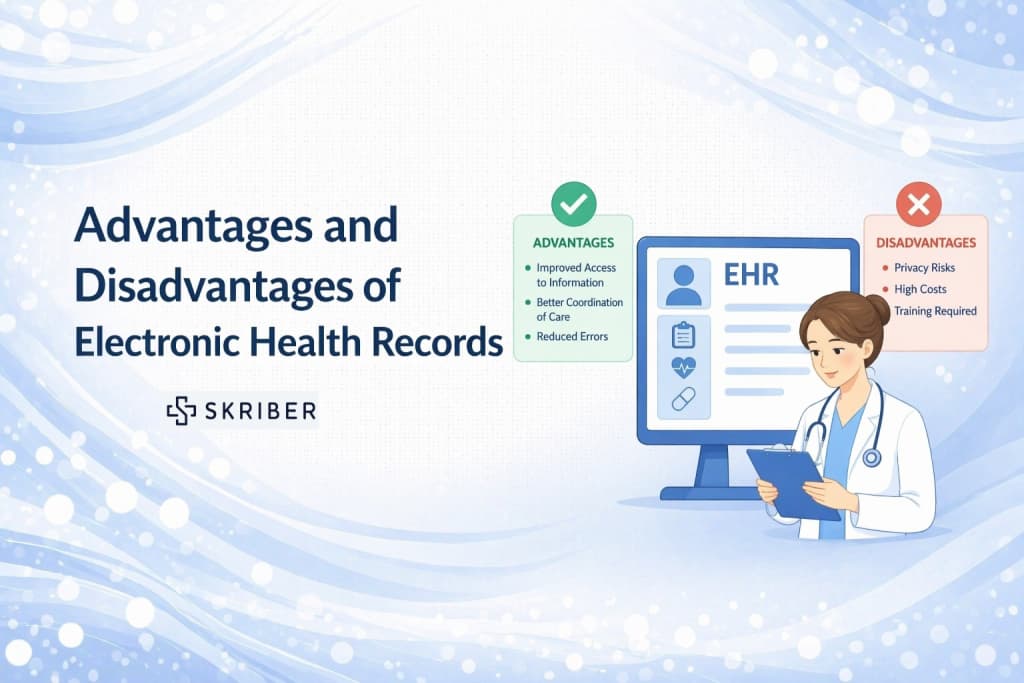
If you work in a clinic, a hospital, or even a home health agency, you spend more time with your computer than you do with some of your family members. That glowing screen holds the Electronic Health Record, or EHR. We used to call it the EMR (Electronic Medical Record), but EHR is the bigger term for the whole patient story. Some days, the EHR saves a life. Other days, it makes us want to throw the keyboard out the window. Whether you are a doctor, nurse, medical assistant, or coder, you have strong feelings about this tool. This blog is not about fancy technical words. It is a real talk about why EHRs are great and why they drive us crazy. We will keep it simple and honest.
Let’s break it down into two clear sides: The Good Stuff and The Hard Stuff.
The Good Side (Advantages of EHRs)
When the power is on and the software is working right, the EHR is a miracle. It changes how we treat patients. Here is exactly how it helps us do our jobs better.
1. You Can Read the Chart
The Problem Before EHRs: I need you to remember the old days. You would open a thick manila folder. Inside, you would find progress notes written by Dr. Smith. Dr. Smith is a genius, but his handwriting looks like a seismograph during an earthquake. You would spend five minutes just trying to figure out if the word was "Morphine" or "Magnesium." That is dangerous.
The EHR Advantage: With an EHR, every word is typed. It is clean. It is clear. When a nurse gives a report or a pharmacist reads an order, there is zero confusion about what the word says. For patient safety, this is number one. No more guessing games.
Why It Matters: A 9th grader can read a typed note. That means fewer medication errors and fewer mistakes because someone misread a scribble. Clarity saves lives. It really is that simple.
2. All the Info in One Place
The Old Way: The patient is in Room 4. They have chest pain. You need to see last month's EKG. Where is it? It is in the paper chart. But the chart is in the basement of Medical Records. Or maybe it is on a cart in a different hallway. Or maybe—and this happens a lot—Dr. Jones took it to her office to finish a note and it is under a stack of journals.
The New Way (EHR): You click a tab. Boom. There is the EKG. There is the lab from last week. There is the note from the specialist across town. You don't even have to leave the patient's bedside. You can pull up their history while talking to them.
Why It Matters: This speed is huge for emergency care. If a patient cannot speak, the EHR can tell you their allergies, their meds, and their past surgeries in seconds. This prevents us from giving a drug they are allergic to or missing a major risk factor.
3. Better Safety Checks
The Computer as a Co-Pilot: EHRs are not just storage bins. They have brains. Let’s say you try to prescribe a new antibiotic. You type it in. Suddenly, a big red box pops up: "WARNING: Patient is Allergic to Penicillin."
That is the EHR doing its best work. It acts like a guardrail on a steep road. It also checks for drug interactions. If you order Drug A and the patient is already on Drug B, and those two don't play nice together, the EHR yells at you.
Why It Matters: We are humans. We are tired. We forget things. The EHR remembers. It is a second set of eyes that never blinks. For busy primary care doctors managing fifteen meds for one elderly patient, this is a must-have tool.
4. Teamwork Without Running Around
Sharing the Ball: Healthcare is a team sport. The doctor orders the test. The nurse draws the blood. The lab tech runs the machine. The specialist reads the result. In the paper world, this is a relay race where the baton gets dropped a lot.
EHR Connection: With an EHR, everyone sees the same screen at the same time (or close to it). The nurse sees the order immediately in the ER. The lab sees the specimen list. The doctor in the ICU can watch the labs trend in real-time. We can send a referral note to a cardiologist across the state line without a fax machine screeching.
Why It Matters: This cuts down on duplicate tests. "Did we already do a CT scan of the belly?" You can check in ten seconds. This saves the patient radiation and saves the system money.
5. The Patient Portal
How It Changes Things: Most EHRs come with a "patient portal." This is a website or app where patients can log in and see their own stuff. They can see lab results. They can request a refill on their blood pressure pill. They can send you a non-urgent message.
The Benefit to Us: This reduces phone tag. Instead of playing voicemail tennis all day, a patient can just type: "Hey, I need a note for work." Or, "My cholesterol is 200. Do I need to come in?" They also show up more prepared because they saw their lab results before the visit.
Why It Matters: When patients see their own A1c go up or down, they take ownership. It makes our job as educators easier. They are not just listening to us; they are seeing the data.
The Not-So-Good Side (Disadvantages of EHRs)
Okay, let's get real. The above section sounds like a brochure from a software company. But we know the truth. The EHR has a dark side. It has changed our workflow in ways that are frustrating and sometimes harmful. Let’s talk about the downsides.
1. The Burnout Problem
What We All Feel: You see patients from 8:00 AM to 5:00 PM. You are "on" all day. You are smiling, listening, and typing. At 5:01 PM, the waiting room is empty. Are you done? No. You now face "The In-Basket." It is full of patient messages, lab results to review, and prescription refills. But the worst part? You have 37 open charts that need finishing.
The Reason: EHRs require us to click boxes to prove we did work. We call it "documentation burden." To bill for a Level 4 visit, you must document a specific number of "elements." This often leads to us writing novels in the chart just to satisfy the computer and the insurance company. This work often bleeds into the evening—hence the term "Pajama Time."
The Result: This is a main driver of healthcare worker burnout. We didn't go to medical school or nursing school to be data entry clerks. We went to help people. The computer has become a third party in the exam room, and it demands the most attention.
2. The Screen in the Exam Room
The Triangle of Awkwardness: There is a patient on the table. There is you on a stool. And there is a large computer monitor. Where do you look? If you look at the patient, you aren't typing. If you type, you are staring at the back of the monitor and the patient is talking to the side of your head.
The Impact: Studies show that when a doctor spends most of the visit staring at the screen, patient satisfaction drops. The patient feels unheard. They feel like a checklist, not a person.
The Hard Truth: We have to look at the screen. The system requires us to check off their smoking status, their depression screening score, and their fall risk. It is hard to be a good listener and a fast typist at the exact same time. It is a skill we never learned in school, and it is exhausting.
3. It Costs a Ton of Money
The Price Tag: EHR software is not like downloading an app on your phone. For a hospital system, the installation can cost millions of dollars. Then there is the cost of training. Then there is the cost of the IT guy who comes to fix it when it freezes. Then there are monthly license fees.
Who Pays? Small private practices often struggle with this. Some older doctors retired early rather than deal with the cost and headache of switching from paper to computer. The cost of the system gets passed down. This is part of the reason healthcare costs keep going up. We are paying for the software to store the data.
4. Alert Fatigue
Ding! Pop! Warning! Remember that great safety guardrail we talked about earlier? The one that prevents allergies? Well, the system is not smart enough to know which warnings are real and which are stupid.
Example: You prescribe Tylenol for a 25-year-old healthy man. POP-UP WARNING: "This medication may cause drowsiness. Avoid heavy machinery." Or you order a routine CBC. POP-UP WARNING: "Duplicate test? This was done 365 days ago."
The Danger: Because we see 100 stupid pop-ups a day, we develop a reflex. We click "Override" or "Close" without reading. Our brain filters out the noise. But what if that one pop-up was actually important? What if it was a real drug interaction? We missed it because the computer cried wolf too many times.
5. They Don't Talk to Each Other
The Great Myth: The promise of the EHR was that everyone would be connected. You break your leg in Florida; the doctor in New York sees the X-ray. This is a lie.
The Reality: Hospital A uses Epic. Hospital B across the street uses Cerner (Oracle). Clinic C uses Athena. These systems are like different languages. They speak French, Spanish, and German. They do not like to share nicely. When a patient comes from Hospital B to Hospital A, we often cannot see their records. We have to ask the patient, "What meds do you take?" and they say, "The little white one."
The Fix (Which is Annoying): We have to log into a separate portal, a state database, or even—yes—use a fax machine to get records from a different system. It is 2026, and we are still faxing because the billion-dollar software won't share.
6. Copy and Paste
The Temptation: You are running late. The patient is stable. Yesterday's note was perfect. Why not just hit "Copy Forward" and change the date?
The Problem: This creates huge, bloated notes that are full of old information. Have you ever opened a note that said: "Patient is intubated and sedated in ICU. Vitals stable." But then you scroll down and see: "Patient walked to bathroom independently." Which one is it?
The Risk: This is a patient safety risk. Outdated data gets carried forward for days or weeks. Someone sees "Leg Swelling +2" from three weeks ago and orders a diuretic, but the swelling is actually gone. The chart becomes a history book, not a current status report.
7. Downtime
The Chaos: The internet goes down. Or the server crashes. Or there is a cyberattack. All of a sudden, the screens go dark. No one can see the medication list. No one can see the allergies. No one can chart vital signs.
The Fallback: We have to scramble for downtime forms. These are pieces of paper on a clipboard. We suddenly forget how to write with a pen. The pharmacy is calling, "What is the dose?" And you have to shout, "I don't know! The computer is down!" It shows how dependent we have become. We are lost without the grid.
The Bottom Line:
So, where does this leave us? Is the EHR good or bad?
The answer is both.
We cannot go back to paper. I know some of us miss the simplicity of a blank sheet of paper where we could draw a picture of a lung or scribble a quick note. But we also cannot ignore the lives saved by legible orders and allergy alerts.
What We Need to Fix: The future of healthcare depends on fixing the user experience. We need software designed by people who actually take care of patients, not just by engineers who write code. We need less clicking. We need better voice-to-text so we can look at the patient while we talk. We need systems that talk to each other freely.
A Message for My Fellow Pros: As we click through our last few boxes tonight before we go home, remember this: The computer is a tool. It is a hammer. Right now, the hammer is a little heavy and the grip is uncomfortable. But it builds a safer house. Let's keep pushing the companies to make it a better hammer.
And if the screen freezes? Take a deep breath. The patient in front of you is more important than the blinking cursor. Stay strong out there.