If you work in healthcare, counseling, or any field where you need to keep records of client interactions, you have probably heard about progress notes. Progress notes are written records that document what happens during a client session. They help track treatment, communicate with other professionals, and meet legal and billing requirements. One popular way to write progress notes is the DARP format. DARP stands for Data, Assessment, Response, and Plan. It is a simple and structured way to document client interactions. This method helps professionals organize their thoughts clearly so that anyone reading the notes can understand the client’s situation and what was done about it.
In this blog, we will explain what DARP notes are, break down each part in simple words, give you tips on how to write them well, and provide four complete examples you can learn from. Whether you are a nurse, therapist, case manager, or counselor, this guide will help you write better DARP notes.
What Does DARP Stand For?
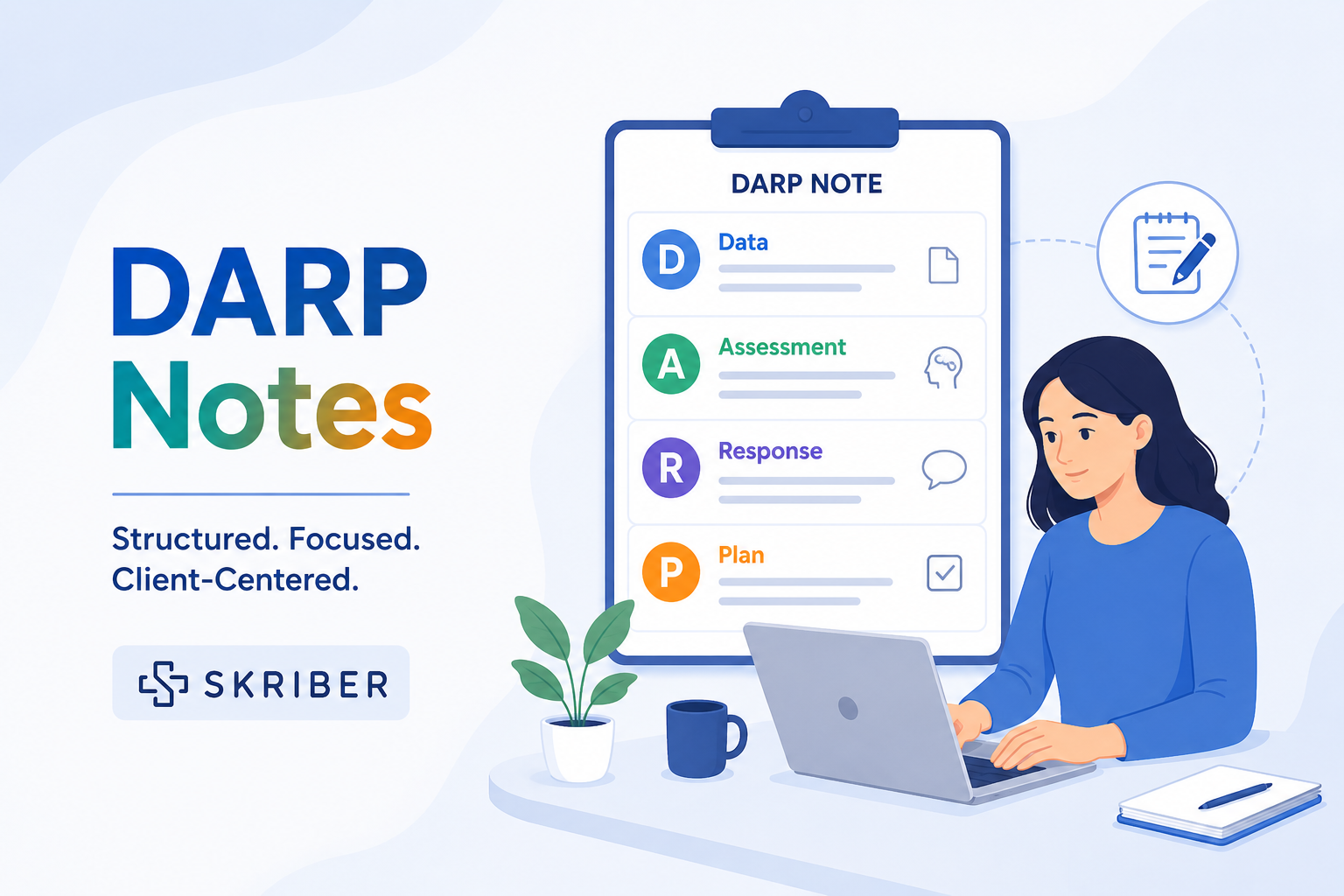
DARP is an acronym with four letters. Each letter stands for a different part of the note:
| Letter | Stands For | What It Means |
|---|---|---|
| D | Data | Facts, observations, and what the client says |
| A | Assessment | Your professional interpretation of the data |
| R | Response | What happened when you took action |
| P | Plan | What will happen next |
Each part has its own purpose. Together, they tell a complete story of the client interaction. The DARP format is different from the similar DAP format because DARP adds the “Response” section. This extra section is very helpful because it lets you track how the client reacted to your interventions.
Data – What You See and Hear
The Data section is the first part of a DARP note. This is where you write down all the facts from the session. Think of it as the “what happened” part.
Two Types of Data
Data comes in two types: subjective and objective.
Subjective data is what the client tells you. This includes their feelings, symptoms, and personal experiences. You should try to use the client’s own words when possible. For example, instead of writing “The client was sad,” you could write, “The client said, ‘I have been feeling really down lately'”.
Objective data is what you can see, hear, or measure. This includes things like:
- Vital signs (blood pressure, heart rate, temperature)
- Body language (crying, fidgeting, eye contact)
- Appearance (grooming, clothing, hygiene)
- Speech patterns (fast, slow, slurred)
- Physical exam findings
What to Include in the Data Section
Here are some things you can include in your Data section:
- The client’s main concerns or reasons for the visit
- Their mood and thoughts
- Any symptoms they are experiencing
- How they are functioning in daily life
- Life updates since the last session
- Important events or triggers they mention
- Test results or scores from assessments
- Any risk factors or safety concerns
Tips for Writing the Data Section
- Be specific. Instead of saying “The client seemed anxious,” say “The client was fidgeting with their hands and speaking quickly”.
- Separate fact from opinion. Only report what you saw and heard. Save your opinions for the Assessment section.
- Use direct quotes when possible. This adds credibility to your notes.
- Include both subjective and objective data. This gives a complete picture.
Assessment – What You Think It Means
The Assessment section is where you share your professional opinion. After gathering all the data, you interpret what it means.
Purpose of the Assessment
The Assessment section helps you:
- Show how the client is doing
- Connect what happened in the session to treatment goals
- Identify patterns or problems
- Explain your clinical reasoning
What to Include in the Assessment Section
Here are some things you can include in your Assessment:
- Your analysis of the client’s condition
- How the client is progressing in treatment
- Any patterns you notice
- What might be causing their problems
- Changes in their mental status
- Your diagnostic impressions
Tips for Writing the Assessment Section
- Be professional, not personal. Avoid opinions like “I think the client is being too hard on herself.” Instead, say “The client demonstrates self-critical thoughts, which may contribute to her avoidance of social situations”.
- Connect back to the data. Your assessment should be based on what you wrote in the Data section.
- Focus on progress and challenges. Show how the client is moving toward their goals or where they are struggling.
- Be concise. This section should be a clear summary of your professional judgment.
Response – What Happened When You Took Action
The Response section is what makes DARP notes unique. This is where you document what you did and how the client reacted.
Why the Response Section Matters
The Response section is important because it:
- Shows what interventions you used
- Tracks how the client reacted
- Helps you decide if your approach is working
- Provides evidence of progress
What to Include in the Response Section
Here are some things you can include in your Response:
- The interventions or techniques you used
- The client’s level of engagement
- Their emotional response to what was discussed
- Any changes in their behavior during the session
- Their feedback on the techniques you used
- Signs of progress or resistance
Tips for Writing the Response Section
- Be specific about interventions. Don’t just say “I provided therapy.” Say “I used cognitive behavioral techniques to help the client identify negative thought patterns”.
- Describe the client’s reaction clearly. For example: “After practicing the breathing exercise, the client said she felt calmer and her heart rate decreased from 90 to 72”.
- Track changes over time. Note if the client is responding better or worse than in previous sessions.
- Include both positive and negative responses. If the client resisted or disagreed, document that too.
Plan – What Happens Next
The Plan section is the final part of a DARP note. This is where you outline the next steps for the client’s care.
Purpose of the Plan
The Plan section helps:
- Guide future sessions
- Keep treatment on track
- Coordinate care with other professionals
- Set goals for the client
What to Include in the Plan Section
Here are some things you can include in your Plan:
- Goals for the client to work on
- Homework or tasks for the client to complete
- Topics to cover in the next session
- Referrals to other professionals
- Changes to medication or treatment
- Safety plans or risk management steps
- The date and time of the next appointment
Tips for Writing the Plan Section
- Make goals specific and measurable. Instead of “Client will feel better,” say “Client will practice deep breathing for 5 minutes each day”.
- Connect to the assessment. Your plan should address the issues you identified in the Assessment section.
- Include both clinician and client responsibilities. Show what you will do and what the client will do.
- Be realistic. Set goals that the client can actually achieve.
How DARP Notes Compare to Other Formats
DARP vs. DAP
DAP notes have three sections: Data, Assessment, and Plan. DARP notes add a Response section. This makes DARP notes more detailed because they track how the client reacted to interventions.
DARP vs. SOAP
SOAP stands for Subjective, Objective, Assessment, and Plan. In SOAP notes, subjective and objective data are separated into two sections. In DARP notes, both types of data are combined into one Data section. This makes DARP notes simpler and faster to write.
AI-Powered • HIPAA-Ready
Let AI handle your clinical notes.
Skriber listens during the visit and creates complete Progress notes in seconds — so you can stay focused on the patient.
-
Capture Ambient listening during sessions
-
Transcribe Speech → text instantly
-
Generate Notes Accurate structured notes
-
Review & sign Edit and finalize instantly
When to Use DARP Notes
DARP notes are especially useful in:
| Setting | Why It Works |
|---|---|
| Mental health counseling | Tracks emotional progress and client responses to therapy |
| Case management | Documents client needs, resources provided, and barriers |
| Substance use treatment | Records triggers, cravings, coping skills, and recovery progress |
| School counseling | Tracks student behaviors and academic challenges |
| Nursing | Documents patient responses to treatments and interventions |
| Psychiatric care | Tracks medication responses and mental status changes |
Common Mistakes to Avoid
When writing DARP notes, watch out for these common errors:
- Mixing up sections. Make sure data stays in Data, opinions stay in Assessment, reactions stay in Response, and future steps stay in Plan.
- Being too vague. Instead of “Client did well,” say “Client participated actively in the session and completed the assigned worksheet.”
- Using judgmental language. Avoid words like “good,” “bad,” or “difficult.” Stick to objective descriptions.
- Forgetting the Response section. This is what makes DARP notes special. Don’t skip it.
- Writing too much or too little. Aim for one clear paragraph per section.
DARP Note Examples
Here are four DARP note examples for different professional settings. Each example shows how to apply the DARP format in real situations.
Mental Health Counseling Session
Client: Sarah, age 34
Date: July 12, 2026
Session: Individual therapy, 50 minutes
Data:
The client arrived on time and was neatly dressed. She reported feeling “overwhelmed and anxious” about her upcoming job interview. She stated she has been having trouble sleeping for the past week, waking up at 3 AM and unable to fall back asleep. She reported feeling “butterflies in my stomach” throughout the day. The client appeared restless, shifting in her seat frequently and tapping her fingers on the armrest. She made minimal eye contact during the first 15 minutes of the session. She reported that her appetite has decreased and she has lost 3 pounds in the past two weeks. She rated her anxiety as 8 out of 10.
Assessment:
The client presents with symptoms consistent with moderate anxiety disorder. Her sleep disturbance, appetite changes, and physical symptoms (restlessness, stomach discomfort) indicate significant distress related to her upcoming job interview. Her avoidance of eye contact and restless behavior suggest high levels of physiological arousal. She appears motivated to address her anxiety but lacks effective coping strategies. Her insight into her condition is good, as she was able to identify specific triggers and symptoms.
Response:
I introduced the client to a simple breathing technique (4-7-8 breathing: inhale for 4 seconds, hold for 7, exhale for 8). We practiced this together for 5 minutes. The client reported feeling “a little calmer” after the exercise. Her physical restlessness decreased, and she was able to make eye contact more comfortably. She expressed interest in learning more coping strategies. She said, “I think this could really help me before the interview.” She was engaged throughout the session and asked thoughtful questions about the techniques.
Plan:
The client will practice the 4-7-8 breathing technique twice daily (morning and before bed) and before her interview. She will track her anxiety levels on a scale of 1-10 in a journal. Next session (scheduled for July 19 at 2 PM) will focus on cognitive restructuring techniques to address negative thoughts about the interview. We will also discuss sleep hygiene strategies. The client agreed to these goals.
Nursing / Medical Setting
Patient: Mr. Johnson, age 72
Date: July 12, 2026
Shift: Day shift, 7 AM – 3 PM
Data:
Patient is a 72-year-old male, post-operative day 2 following right hip replacement surgery. Vital signs at 8 AM: BP 142/88, HR 92, RR 20, Temp 99.1°F oral, SpO2 96% on room air. Patient reports pain at the surgical site rated 7 out of 10 on the pain scale. He describes the pain as “sharp” and “aching.” He states the pain is worse when he tries to move his leg. He was observed grimacing when repositioning in bed. He has been reluctant to participate in physical therapy exercises. He is alert and oriented to person, place, and time. His surgical dressing is clean and dry with no signs of drainage. His urine output for the past 8 hours was 400 mL.
Assessment:
The patient is experiencing moderate to severe post-operative pain that is interfering with his ability to participate in physical therapy. His reluctance to move suggests fear of pain, which may delay his recovery. His vital signs are slightly elevated, which is consistent with pain. His surgical site appears to be healing appropriately with no signs of infection. His hydration status appears adequate based on urine output. He may benefit from more aggressive pain management to facilitate mobility and prevent complications such as deep vein thrombosis or pneumonia.
Response:
I administered the prescribed PRN pain medication (Oxycodone 5 mg) at 8:30 AM. I also repositioned the patient with the assistance of a second staff member, using pillows to support his surgical leg. I provided education about the importance of early mobilization for preventing complications. I assisted him with range-of-motion exercises for his ankle and foot. At 9:30 AM, the patient reported his pain had decreased to 4 out of 10. He was more willing to participate in physical therapy and successfully completed 5 repetitions of the prescribed exercises with the physical therapist. He expressed appreciation for the pain management and said, “I feel much better now.”
Plan:
Continue to monitor pain levels every 2 hours and administer pain medication as ordered. Encourage the patient to request medication before pain becomes severe. Assist with physical therapy exercises twice daily. Monitor surgical site for signs of infection. Next pain assessment at 11 AM. The patient will be encouraged to use the incentive spirometer every hour to prevent respiratory complications. Notify the physician if pain remains above 5/10 despite medication.
Substance Use / Addiction Recovery
Client: Michael, age 28
Date: July 12, 2026
Session: Individual counseling, 45 minutes
Data:
The client arrived 10 minutes late to the session. He appeared tired with dark circles under his eyes. He reported that he has been sober for 45 days. He stated he has been having “strong cravings” for alcohol over the past three days, especially in the evenings. He reported that he has been attending AA meetings regularly (5 meetings in the past week). He shared that he was recently offered a drink at a social gathering and declined, but “it was really hard.” He reported difficulty sleeping and feeling irritable. He completed his daily gratitude journal for 6 out of the past 7 days. He stated, “I’m proud of my sobriety, but I’m scared I might relapse.” He was tearful when discussing his fear of letting down his family.
Assessment:
The client is in the maintenance phase of recovery but is experiencing significant cravings and emotional distress. His recent social situation was a high-risk trigger, and while he successfully avoided alcohol, the experience was challenging. His sleep disturbance and irritability may be symptoms of post-acute withdrawal syndrome. He demonstrates good insight into his condition and is actively engaged in his recovery (attending meetings, journaling). However, his fear of relapse suggests a need for additional coping strategies and relapse prevention planning. He appears motivated and committed to his sobriety.
Response:
I validated the client’s feelings and praised his success in declining alcohol at the social gathering. We explored the situation in detail, identifying the specific triggers (being around others who were drinking, feeling social pressure). We practiced a cognitive restructuring exercise where he challenged the thought “I can’t handle this” and replaced it with “I have handled this before, and I can do it again.” We also discussed the “play the tape through” technique, where he imagines the consequences of drinking. The client engaged well with these techniques. He said, “I think these tools will really help me next time.” He appeared more hopeful and less anxious by the end of the session.
Plan:
The client will continue attending AA meetings daily for the next week. He will reach out to his sponsor if he experiences cravings. He will practice the “play the tape through” technique when cravings occur. Next session (scheduled for July 19 at 10 AM) will focus on developing a detailed relapse prevention plan. He will also discuss his sleep difficulties with his physician at his next appointment. The client agreed to call his sponsor before the next session.
School Counseling / Case Management
Student: Marcus, age 16
Date: July 12, 2026
Session: School counseling, 30 minutes
Data:
The student was referred by his math teacher due to declining grades and lack of participation in class. He arrived on time but appeared withdrawn. He was wearing a hoodie with the hood up and avoided eye contact. He spoke in a low, quiet voice. He reported that he has been “having a hard time” focusing in class. He stated he has been staying up late playing video games and is “exhausted” during the day. He reported that his parents recently separated and he is “stressed out” about the situation. He stated he has not been completing his homework and his grades have dropped from B’s to D’s in the past month. He said, “I just don’t care about school anymore.”
Assessment:
The student is experiencing significant distress related to his parents’ separation, which is negatively impacting his academic performance and engagement. His withdrawal, lack of eye contact, and quiet speech suggest depression or adjustment disorder. His sleep disturbance (staying up late) and fatigue are likely contributing to his difficulty concentrating in class. He shows signs of hopelessness (“I just don’t care”). However, he was willing to attend the counseling session and discuss his problems, which indicates some openness to support. He may benefit from additional mental health support and academic accommodations.
Response:
I provided a safe, non-judgmental space for the student to express his feelings about his parents’ separation. I validated his emotions and normalized his reactions, explaining that it is common to struggle with focus and motivation during stressful times. We identified the connection between his sleep schedule, fatigue, and difficulty concentrating. We discussed small, manageable steps he could take to improve his situation. He engaged in the conversation slowly at first but became more open as the session progressed. He said, “I guess talking about it helps a little.” He agreed to try the suggestions we discussed.
Plan:
The student will set a bedtime of 11 PM and limit video games to 1 hour before bed. He will meet with his teachers to discuss extensions on overdue assignments. He will check in with the school counselor twice weekly for the next month. The counselor will contact the student’s parents to discuss the situation and explore the possibility of family counseling. Next session scheduled for July 15 at 1 PM. The student agreed to these goals and said he would try to implement the sleep schedule.
Tips for Writing Better DARP Notes
Be Specific: Use concrete details rather than vague statements. Instead of saying “The client was upset,” say “The client cried and stated, ‘I feel like giving up'”.
Use Direct Quotes: Quoting the client adds credibility and shows exactly what was said.
Distinguish Between Fact and Interpretation: Keep facts in Data and your professional opinion in Assessment.
Be Concise: Aim for one clear paragraph per section. Your notes should be thorough but not overly long.
Keep It Professional: Avoid emotional language and personal judgments. Stick to objective, professional observations.
Document Promptly: Write your notes as soon as possible after the session while the details are still fresh in your mind.
Review Previous Notes: Before writing a new note, review the previous one to ensure continuity of care.
Conclusion
DARP notes are a valuable tool for professionals who need to document client interactions clearly and efficiently. By organizing your notes into Data, Assessment, Response, and Plan, you create a complete record that is easy to understand and useful for treatment planning. The Data section captures what happened. The Assessment section shows what you think it means. The Response section documents what you did and how the client reacted. The Plan section outlines what happens next. Together, these four parts tell the full story of the client’s care. Whether you work in mental health, nursing, case management, or school counseling, DARP notes can help you write better, more organized progress notes. They save time, improve communication, and support better client outcomes. Start using the DARP format today. With practice, it will become a natural and valuable part of your professional documentation.
for clinicians · HIPAA-ready
Spend more time with patients, not paperwork.
Skriber transforms ambient speech into accurate Progress notes — finished before your next session.
No credit card required.


Dr. Connor Yost is an Internal Medicine resident at Creighton University School of Medicine in Arizona and an emerging leader in clinical innovation. He currently serves as Chief Medical Officer at Skriber, where he helps shape AI-powered tools that streamline clinical documentation and support physicians in delivering higher-quality care. Dr. Yost also works as a Strategic Advisor at Doc2Doc, lending his expertise to initiatives that improve financial wellness for physicians and trainees.
His professional interests include medical education, workflow redesign, and the responsible use of AI in healthcare. Dr. Yost is committed to building systems that allow clinicians to spend more time with patients and less on administrative tasks. Outside of medicine, he enjoys photography, entrepreneurship, and family life.