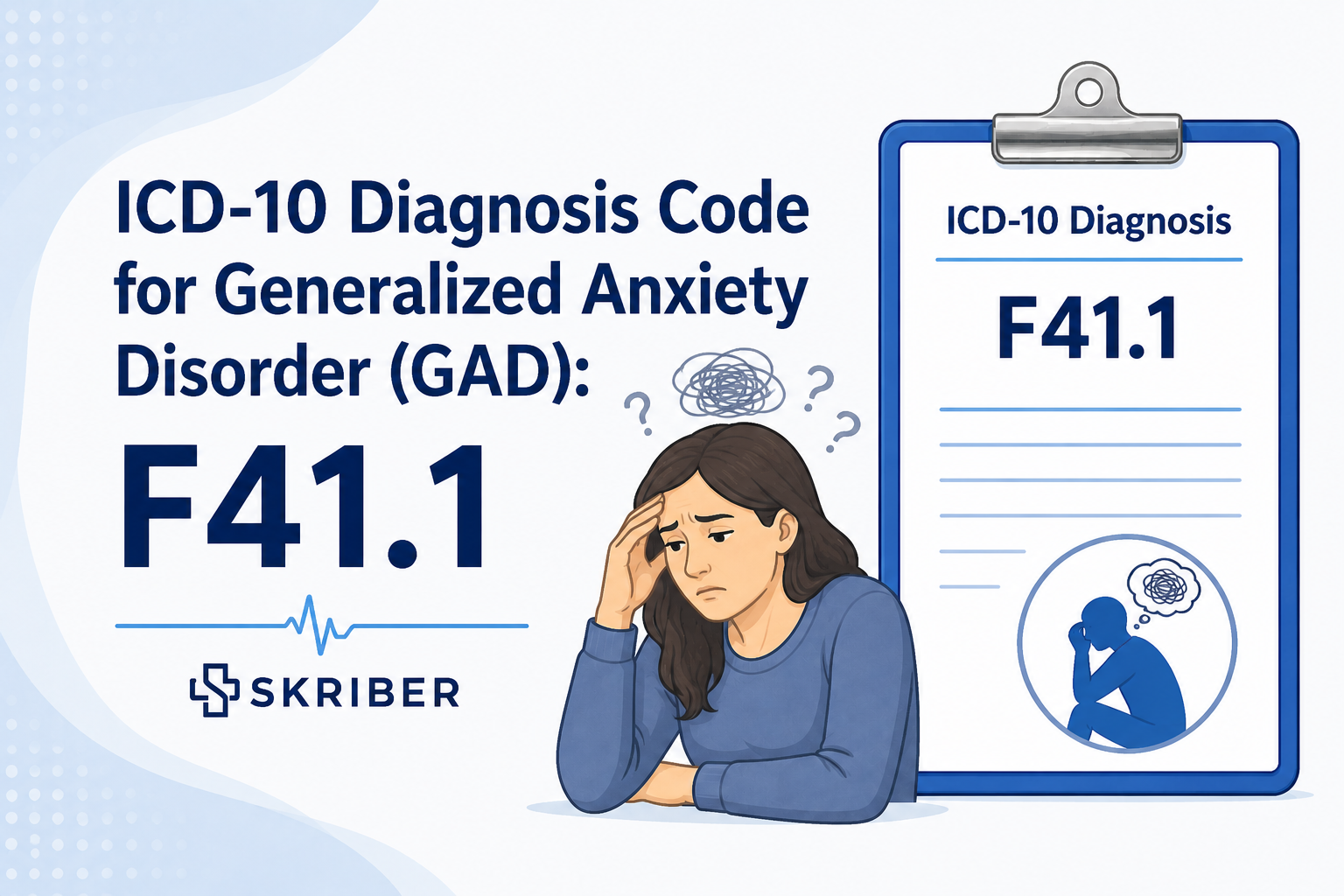
We see patients every day who feel worried all the time. They cannot seem to turn off their anxious thoughts. This is different from normal stress before a test or a big meeting. This is a real medical condition that needs a proper diagnosis and a correct code. The right code helps us do three important things. First, it helps us show that the patient has a true illness, not just a bad mood. Second, it allows us to bill insurance companies for our time and treatment. Third, it helps us track how many people have this illness so we can plan better care. For Generalized Anxiety Disorder (GAD), the correct ICD-10 code is F41.1. This code lives under a bigger group called “Neurotic, stress-related and somatoform disorders” (F40-F48). Knowing this one code makes your paperwork cleaner and your patient’s record clearer.
What Does F41.1 Mean? Breaking Down the Code
The ICD-10 system organizes diseases like a family tree. The letter “F” means the problem is related to mental health or behavior. The number “41” points to a specific group of anxiety disorders. The final “.1” tells us it is Generalized Anxiety Disorder, not panic disorder or another type.
When you use F41.1, you are saying that your patient has too much anxiety and worry. This worry happens on most days for at least six months. The worry is not about one small thing, like a bug or a test. Instead, the worry is about many life areas like money, health, family, or work.
The patient finds it very hard to control the worry. They cannot just “stop thinking about it.” The anxiety also comes with physical symptoms like feeling tired, having tense muscles, or trouble sleeping. This code separates GAD from normal worry that comes and goes quickly.
Key Diagnostic Features for F41.1
Before you use the F41.1 code, make sure the patient truly has GAD. The ICD-10 gives us a list of symptoms to look for. You need to see at least four of these physical or mental signs most days for the past six months.
Here are the main symptoms to check for:
- Muscle tension – The patient feels tight in the neck, shoulders, or jaw. They may grind their teeth.
- Autonomic arousal – This means a “fight or flight” response. Signs include a fast heart rate, sweaty palms, dry mouth, or dizziness.
- Hypervigilance – The patient always feels on edge. They jump at small sounds. They cannot relax.
- Sleep problems – They have trouble falling asleep or staying asleep. Their mind races at night.
- Fatigue – Even without hard work, they feel very tired. The constant worry drains their energy.
- Irritability – Small things make them angry or frustrated. They know it is not rational, but they cannot help it.
The Six-Month Rule
You must be sure the symptoms have lasted for six months or more. A patient who just started feeling very worried two weeks ago after a car crash does not have GAD. They may have an acute stress reaction. For F41.1, the anxiety is a long-term guest, not a short visitor.
Also, the anxiety must cause clear problems in the patient’s life. They might miss work because they cannot focus. They might avoid social events. Their family relationships may suffer. If the anxiety exists but does not hurt their daily function, you may need to re-think the diagnosis.
How F41.1 Differs From Other Anxiety Codes
Many anxiety disorders look alike at first glance. But the ICD-10 gives them different codes for good reason. Each one needs a different treatment plan. Using the wrong code can lead to the wrong medicine or therapy.
The table below shows the most common anxiety codes and how they differ from F41.1.
| ICD-10 Code | Disorder Name | Main Difference from GAD (F41.1) |
|---|---|---|
| F41.0 | Panic Disorder | Has sudden “attacks” of intense fear, not steady worry. |
| F40.01 | Agoraphobia | Fear of open spaces or crowds. Often avoids leaving home. |
| F40.1 | Social Phobia | Fear of being watched or judged by others. Not general worry. |
| F42 | OCD | Has repeated actions (rituals) to reduce anxiety. GAD has no rituals. |
| F43.1 | PTSD | Starts after a trauma (like a war or assault). GAD has no single trigger. |
When Two Problems Happen Together
It is very common for a patient to have GAD and another mental health problem. For example, many people with GAD also have depression (code F32.9 or F33.9). In this case, you can code both. Write F41.1 first if anxiety is the main problem. Write the depression code second.
But do not code F41.1 if the anxiety is only caused by drugs or alcohol. For example, a patient who drinks too much coffee or uses cocaine may look like they have GAD. But the right code is a substance-induced disorder (F10-F19). Treat the substance use first, and the anxiety may go away.
Documenting F41.1 Correctly in the Patient’s Chart
Good documentation protects you and helps the patient. Insurance companies often deny claims for F41.1 if the notes are too vague. You must write down clear proof that the patient meets the six-month rule and has four or more physical symptoms.
Here is a simple checklist to put in your notes:
- Patient reports worry on most days for at least six months
- Worry is about three or more life areas (example: work, health, money)
- Patient says they cannot control the worry
- Three or more physical symptoms present (tension, fatigue, sleep trouble, etc.)
- No other medical or drug cause found
- Anxiety hurts daily function (work, school, or relationships)
A Sample Note for F41.1
You can write something like this in your chart:
*”Patient is a 34-year-old female who reports daily worry about her job, her children’s safety, and her own health for the past eight months. She states, ‘I cannot turn my brain off.’ She reports muscle tension in her neck, trouble sleeping (waking at 2 AM), and feeling tired all the time. She has missed five work days this month due to feeling overwhelmed. No alcohol or drug use. No thyroid problems on recent labs. Diagnosis: Generalized Anxiety Disorder (F41.1).”*
This kind of note makes it easy for another doctor to understand your decision. It also gives insurance reviewers the evidence they need to approve your claim.
Treatment Options for Patients With F41.1
Once you assign the F41.1 code, you need a treatment plan. The good news is that GAD responds very well to both therapy and medicine. Many patients get much better within a few months of starting treatment.
First-Line Therapy: Cognitive Behavioral Therapy (CBT)
CBT is the most proven talk therapy for GAD. In simple words, CBT helps the patient see that their worry thoughts are not facts. A therapist teaches them to ask, “What is the real evidence for this fear?” Over time, the brain learns a new, calmer pattern.
CBT for GAD usually takes 12 to 20 sessions. The patient also gets homework, like writing down worries and testing if they come true. Most patients see a big drop in anxiety after 8 to 10 weeks of weekly sessions.
AI-Powered • HIPAA-Ready
Let AI handle your clinical notes.
Skriber listens during the visit and creates complete Progress notes in seconds — so you can stay focused on the patient.
-
Capture Ambient listening during sessions
-
Transcribe Speech → text instantly
-
Generate Notes Accurate structured notes
-
Review & sign Edit and finalize instantly
Medicine Options
When therapy alone is not enough or not available, medicine can help. First-line drugs for GAD include:
| Drug Class | Examples | What To Know |
|---|---|---|
| SSRIs | Sertraline (Zoloft), Escitalopram (Lexapro) | Start low, go slow. May take 4-6 weeks to work. First choice for most patients. |
| SNRIs | Venlafaxine XR (Effexor XR), Duloxetine (Cymbalta) | Also good for pain if patient has both GAD and chronic pain. |
| Buspirone | Buspar | Not addictive. Works best for patients new to anxiety meds. Takes 2-4 weeks. |
| Benzodiazepines | Lorazepam (Ativan), Clonazepam (Klonopin) | Use with caution. Works fast but high risk for addiction. Only for short-term use (2-4 weeks). |
Do not use benzodiazepines as a first-line treatment for GAD. They are safe for a few days during a crisis. But long-term use leads to tolerance (needing more to get the same effect) and dependence. SSRIs or SNRIs are safer for chronic use.
Special Situations and Comorbidities
GAD rarely travels alone. Many patients with F41.1 also have other health problems. You need to know how to code these situations correctly.
GAD and Depression
This is the most common pair. Up to 60% of people with GAD also have major depression (F32.9). The two illnesses feed each other. Anxiety makes the patient too tired to do fun things, which leads to depression. Depression makes the patient feel hopeless, which makes anxiety worse.
When both are present, treat the one that hurts the patient more. If the patient cannot sleep or eat due to worry, start with GAD treatment. If the patient has suicidal thoughts, treat depression first. You can code both F41.1 and F32.9 on the same claim.
GAD and Medical Illnesses
Patients with chronic physical illnesses often have GAD. For example, a patient with diabetes may worry constantly about their blood sugar. A patient with heart disease may worry every day about having a heart attack.
In these cases, you still code F41.1 if the worry is far more than normal. It is normal to check your blood sugar. It is not normal to check it 20 times a day and cry each time. The medical illness gets its own code (like E11.9 for diabetes). The GAD gets F41.1. Both need treatment.
GAD in Older Adults
Older patients often have GAD but hide it. They may not say “I feel anxious.” Instead, they say “My stomach hurts” or “I can’t sleep” or “I feel shaky.” These physical complaints are the body’s way of showing anxiety.
When you see an older patient with new physical symptoms but normal tests, think of F41.1. Treating their anxiety may cure their stomach pain or insomnia. Just be careful with medicines. Older adults need lower starting doses of SSRIs (like half of a normal adult dose).
Pitfalls to Avoid When Using F41.1
Even good doctors sometimes make mistakes with this code. Here are the most common errors and how to avoid them.
Coding F41.1 Too Early
You cannot code GAD after one visit. The patient must have symptoms for six months. If they come in after three weeks of worry, use a temporary code. Try R45.1 (Restlessness and agitation) or Z71.1 (Person with feared complaint in whom no diagnosis is made). Then re-check at the six-month mark.
Missing a Medical Cause
Many medical problems look exactly like GAD. An overactive thyroid (E05.90) causes shaking, fast heartbeat, and irritability. Low blood sugar (E16.2) causes sweating and confusion. Even too much caffeine can mimic GAD.
Always order a basic blood test before finalizing F41.1. Check thyroid function (TSH), blood sugar, and vitamin B12 levels. A low B12 can cause anxiety and fatigue. Fix the medical problem first. If anxiety remains after treatment, then use F41.1.
Forgetting to Re-assess
GAD is not always a lifelong sentence. Some patients get fully better after 6 to 12 months of treatment. If their worry goes away completely, you should stop using F41.1. Change the code to Z86.59 (Personal history of other mental and behavioral disorders). This tells future doctors that the patient once had GAD but is now well.
Billing and Reimbursement Tips for F41.1
Insurance companies watch mental health codes closely. They sometimes deny F41.1 claims if they think the patient just has “normal stress.” You can fight this by linking your note to the official criteria.
Using the Right Visit Codes
The F41.1 code is the diagnosis. You also need a procedure code (CPT code) for the visit. Common pairings include:
- 99213 or 99214 – For a regular office visit where you diagnose GAD and start a treatment plan.
- 90832, 90834, or 90837 – For therapy sessions (CBT) for GAD. The number shows how many minutes (30, 45, or 60).
- 99215 – For a longer, complex visit when the patient has GAD plus two other health problems.
How to Beat a Denial
If an insurance company denies F41.1, do not give up. Write a short appeal letter. Include three things:
- The date symptoms started (must be 6+ months ago).
- The number of physical symptoms (list all four or more).
- How anxiety hurts daily function (example: “Missed 10 work days in 2 months”).
Most denials get overturned with this evidence. Keep a template letter on your computer so you can send it quickly.
Summary: Key Takeaways for F41.1
Let us review the most important facts about the ICD-10 code for generalized anxiety disorder.
F41.1 is the correct code for patients with:
- Too much worry on most days for at least six months
- Worry about three or more life areas (money, health, family, work)
- At least four physical symptoms (tension, fatigue, sleep trouble, irritability, etc.)
- Clear problems with daily function due to anxiety
Do NOT use F41.1 for:
- Worry lasting less than six months (use a temporary code)
- Anxiety only caused by drugs, alcohol, or a medical problem (treat the cause first)
- Panic attacks without general worry (use F41.0 instead)
- OCD with rituals (use F42 instead)
Treatment basics:
- First line: CBT therapy for 12-20 sessions
- First-line medicines: SSRIs (sertraline, escitalopram) or SNRIs (venlafaxine)
- Avoid benzodiazepines for long-term use due to addiction risk
Final Words
Using F41.1 correctly is a skill that gets better with practice. When you first start, you may worry about using the wrong code. That is normal. But remember: a good diagnosis with the right code leads to the right treatment. And the right treatment changes lives. Your patients with GAD have suffered for a long time. Many have been told to “calm down” or “stop worrying so much.” By giving them the correct F41.1 diagnosis, you are telling them a different message. You are saying: “This is a real medical condition. There is a name for it. And there is help for it.”
Take the extra five minutes to document the six-month history and the four physical symptoms. It makes your claim stronger and your patient’s record clearer. You can do this. Your patients are counting on you to get it right.
for clinicians · HIPAA-ready
Spend more time with patients, not paperwork.
Skriber transforms ambient speech into accurate Progress notes — finished before your next session.
No credit card required.


Dr. Connor Yost is an Internal Medicine resident at Creighton University School of Medicine in Arizona and an emerging leader in clinical innovation. He currently serves as Chief Medical Officer at Skriber, where he helps shape AI-powered tools that streamline clinical documentation and support physicians in delivering higher-quality care. Dr. Yost also works as a Strategic Advisor at Doc2Doc, lending his expertise to initiatives that improve financial wellness for physicians and trainees.
His professional interests include medical education, workflow redesign, and the responsible use of AI in healthcare. Dr. Yost is committed to building systems that allow clinicians to spend more time with patients and less on administrative tasks. Outside of medicine, he enjoys photography, entrepreneurship, and family life.