As a healthcare professional, you write notes every day. These notes tell the story of your patient’s care. Good notes help other doctors understand what happened. Bad notes can cause confusion and mistakes. Two popular ways to write notes are SOAP notes and DAP notes. Both work well. But they are different. In this blog we will explain both methods. You will learn which one fits your work best. Let’s get started.
What Are SOAP Notes?
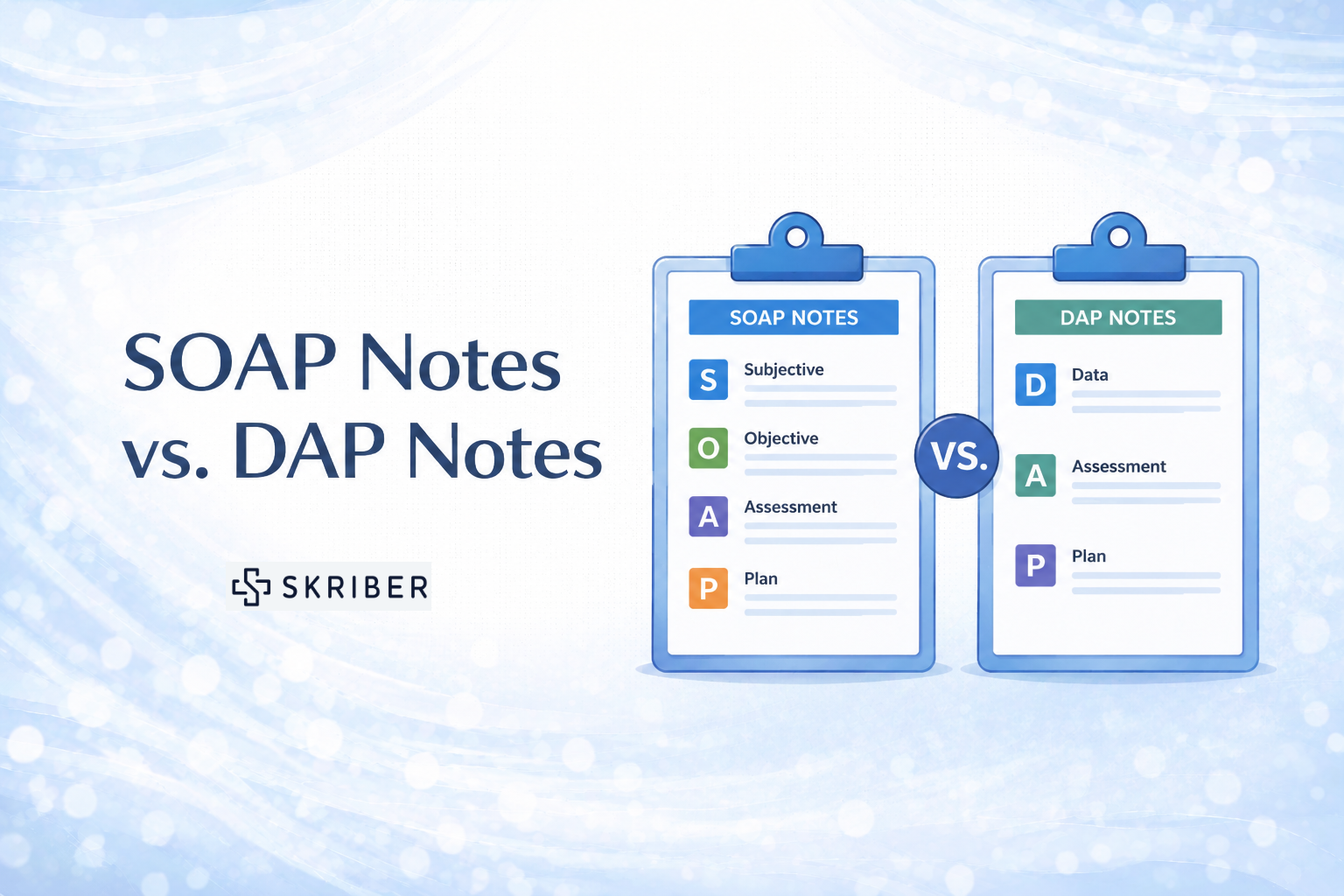
SOAP is a short form. Each letter stands for one part of the note.
S stands for Subjective
O stands for Objective
A stands for Assessment
P stands for Plan
Doctors have used SOAP notes for many years. They are very common in hospitals and clinics.
Breaking Down SOAP Notes
Subjective (S): This part holds what the patient tells you. It is their story. Their feelings. Their words. For example: “My head hurts since yesterday.” Or “I feel tired all the time.” You write this down just as the patient says it. Do not change their words. Do not add your own thoughts yet.
Objective (O): This part holds what you see, hear, touch, or measure. It is the facts. Things like blood pressure, temperature, heart rate. Also what you see on exam. For example: “Blood pressure 130/85. Heart rate 72. Lungs clear to auscultation.” You also put lab results here. Or X-ray findings. Nothing from the patient. Only your own observations and test results.
Assessment (A): This part holds your medical thinking. You put the diagnosis here. Or the list of possible problems. You explain what you think is wrong. For example: “Patient has tension headache. No signs of migraine. No fever or stiff neck.” You also talk about how the patient is doing. Are they getting better? Worse? The same?
Plan (P): This part holds what you will do next. What tests to order. What medicines to give. What the patient should do at home. When to come back. For example: “Give ibuprofen 400mg. Have patient rest in dark room. Follow up in 3 days if no better.”
Example of a SOAP Note
Let me show you a full SOAP note for a patient with a sore throat.
S: “My throat has hurt for two days. It hurts worse when I swallow. I have no fever at home.”
O: Vital signs: Temp 98.6, BP 118/76, HR 82. Throat exam: Redness present. No white spots. No swelling. Rapid strep test: Negative.
A: Viral pharyngitis. No evidence of bacterial infection.
P: Give patient list of home care tips. Use warm salt water gargles. Drink warm tea with honey. Return to clinic if fever develops or if throat pain lasts more than 5 days.
See how clear that is? Each part has its own place. Nothing gets mixed up.
What Are DAP Notes?
DAP is also a short form. It has three parts instead of four.
D stands for Data
A stands for Assessment
P stands for Plan
DAP notes are newer than SOAP notes. Many mental health providers use DAP notes. But medical doctors use them too. They are simpler and faster.
Breaking Down DAP Notes
Data (D): This part mixes together the Subjective and Objective parts from SOAP. You put everything you heard and saw right here. Patient statements. Vital signs. Exam findings. Lab results. All in one place. For example: “Patient says throat hurts for 2 days. Temp 98.6. Throat red but no white spots. Rapid strep test negative.”
Assessment (A): This part works just like the Assessment in SOAP. You put your diagnosis and medical thinking here. What do you think is wrong? How is the patient doing?
Plan (P): This part also works just like the Plan in SOAP. You put your next steps here. What will you do for the patient?
AI-Powered • HIPAA-Ready
Let AI handle your clinical notes.
Skriber listens during the visit and creates complete Progress notes in seconds — so you can stay focused on the patient.
-
Capture Ambient listening during sessions
-
Transcribe Speech → text instantly
-
Generate Notes Accurate structured notes
-
Review & sign Edit and finalize instantly
Example of a DAP Note
Same patient with sore throat. Now written as a DAP note.
D: Patient reports throat pain for 2 days. Pain worsens with swallowing. Denies fever at home. Vital signs: Temp 98.6, BP 118/76, HR 82. Throat exam shows redness. No white spots. No swelling. Rapid strep test negative.
A: Viral pharyngitis. No bacterial infection.
P: Home care instructions given. Warm salt water gargles. Warm tea with honey. Return if fever develops or if throat pain lasts more than 5 days.
Notice the Data part holds both patient words and exam findings. Fewer sections. Faster to write.
Key Differences Between SOAP and DAP
Now let’s compare them side by side. Here are the big differences.
Number of Parts
SOAP has four parts. DAP has three parts. SOAP separates Subjective and Objective. DAP puts them together as Data.
Where Patient Words Go
In SOAP, patient words go only in Subjective. Nothing else. In DAP, patient words go in Data along with exam findings.
Where Exam Findings Go
In SOAP, exam findings go only in Objective. In DAP, they go in Data.
Level of Detail
SOAP notes often have more detail. The separation forces you to be clear about what came from the patient and what came from you. DAP notes are simpler but can mix things together.
Speed of Writing
DAP notes are usually faster. Fewer sections means less time switching between categories. SOAP notes take a bit longer but give better organization.
Best Uses
SOAP notes work great for:
- Hospital settings
- Emergency rooms
- Primary care clinics
- Team-based care where many people read the note
- Teaching students
DAP notes work great for:
- Mental health counseling
- Busy outpatient clinics
- Private practice
- When you need very fast notes
- When you work alone or with a small team
Pros and Cons of SOAP Notes
Let me list the good and bad of SOAP notes.
Pros of SOAP Notes
Very clear separation. Everyone knows where to look for patient story versus exam findings.
Good for teaching. New doctors and students learn to separate facts from opinions.
Works in court. Lawyers and judges understand SOAP notes. They are standard.
Reduces mistakes. When you separate Subjective and Objective, you are less likely to mix up what the patient said with what you saw.
Easy to share. Other doctors know the format. They can read your note fast.
Cons of SOAP Notes
Takes more time. Writing four sections takes longer than three.
Too detailed for some settings. In a busy clinic, you may not need that much separation.
Can feel repetitive. Sometimes the same information fits in two places.
Harder to learn at first. New users mix up Subjective and Objective sometimes.
Pros and Cons of DAP Notes
Now the good and bad of DAP notes.
Pros of DAP Notes
Very fast. Three sections mean less writing time. More time with patients.
Simple to learn. Most people get it right away. Data, Assessment, Plan. Easy to remember.
Less repetitive. You do not separate patient words from exam findings. You just write it all once.
Good for talk therapy. Mental health notes often focus on patient story and your reaction. DAP fits that well.
Less intimidation. New staff feel more comfortable with DAP.
Cons of DAP Notes
Less clear separation. A reader cannot easily tell what the patient said versus what you observed. This can cause confusion.
Not as standard. Many hospitals and clinics expect SOAP. They may not accept DAP.
More risk of bias. When you mix patient words with your observations, you might accidentally change what the patient meant.
Harder to use in court. Lawyers may ask you to separate patient statements from your findings. DAP makes that hard.
When Should You Use Each One?
This is the most important question. Here is my advice as a medical professional.
Use SOAP Notes When:
- You work in a hospital
- You are a medical student or resident
- Many different doctors will read your notes
- Your patient has complex medical problems
- You might go to court about this case
- Your clinic or hospital requires SOAP format
- You are writing a note for a patient you do not know well
Use DAP Notes When:
- You work in a busy outpatient clinic
- You are a mental health provider
- You see patients for brief visits
- You know your patients very well
- You work alone or in a very small practice
- You need to write many notes very fast
- Your notes are mostly for yourself or one or two other people
Real Patient Example: Both Formats
Let me show you the same patient written both ways. This will help you see the difference clearly.
Patient story: A 45-year-old woman comes in saying she feels dizzy when she stands up. She says it started three days ago. You check her blood pressure lying down and standing up. Lying down it is 120/80. Standing up it is 90/60. You think she may be dehydrated. You order blood work and tell her to drink more water.
SOAP Note version:
S: “I feel dizzy when I stand up. It started three days ago. I have been drinking less water because I am busy at work.”
O: BP lying: 120/80. BP standing: 90/60. Heart rate lying: 72. Heart rate standing: 94. Skin turgor normal. Mucous membranes slightly dry.
A: Orthostatic hypotension likely due to mild dehydration. No signs of severe dehydration or other causes at this time.
P: Order basic metabolic panel. Instruct patient to drink 2-3 liters of water daily for next 3 days. Return sooner if dizziness worsens or if she faints. Follow up in 1 week.
DAP Note version:
D: Patient reports dizziness upon standing for 3 days. Reports decreased water intake due to busy work schedule. BP lying 120/80. BP standing 90/60. HR lying 72, standing 94. Skin turgor normal. Mucous membranes slightly dry.
A: Orthostatic hypotension likely from mild dehydration.
P: Order basic metabolic panel. Patient instructed to drink 2-3 liters water daily for 3 days. Return sooner if dizziness worsens or fainting occurs. Follow up in 1 week.
Both notes tell the same story. SOAP separates patient words from exam findings. DAP mixes them. Both are correct. Which one you pick depends on your setting and your needs.
Final Thoughts: Which One Is Best?
There is no single best format. The best format is the one that works for you and your patients. If you work in a big hospital, learn SOAP. It is the standard. Your bosses expect it. Your colleagues use it. If you work in a small clinic or mental health practice, try DAP. It is faster. It gives you more time with patients.
Many doctors use both. They use SOAP for complex cases and new patients. They use DAP for quick follow-ups and stable patients. The most important thing is not the format. The most important thing is that you write clear, honest, helpful notes. Your notes protect your patients. Your notes protect you. Take them seriously.
Start today. Pick one format. Practice it until it feels natural. Then try the other format. See which one fits your hands better. Your patients will not see your notes. But good notes mean good care. And good care is why you became a healthcare professional.
for clinicians · HIPAA-ready
Spend more time with patients, not paperwork.
Skriber transforms ambient speech into accurate Progress notes — finished before your next session.
No credit card required.


Dr. Connor Yost is an Internal Medicine resident at Creighton University School of Medicine in Arizona and an emerging leader in clinical innovation. He currently serves as Chief Medical Officer at Skriber, where he helps shape AI-powered tools that streamline clinical documentation and support physicians in delivering higher-quality care. Dr. Yost also works as a Strategic Advisor at Doc2Doc, lending his expertise to initiatives that improve financial wellness for physicians and trainees.
His professional interests include medical education, workflow redesign, and the responsible use of AI in healthcare. Dr. Yost is committed to building systems that allow clinicians to spend more time with patients and less on administrative tasks. Outside of medicine, he enjoys photography, entrepreneurship, and family life.