Why This Code Matters in Your Daily Practice
As a healthcare professional, you know that coding is not just about billing. It is about telling a clear story of your patient’s health. The right code helps other providers understand the diagnosis. It also ensures the patient gets the right approval for imaging, therapy, or surgery. Cervical radiculopathy is a common problem in primary care, orthopedics, and neurology. Patients come in with neck pain that shoots down the arm. They may report numbness, tingling, or weakness in their hand or fingers. Using the correct ICD-10 code from the start prevents claim denials and audits later.
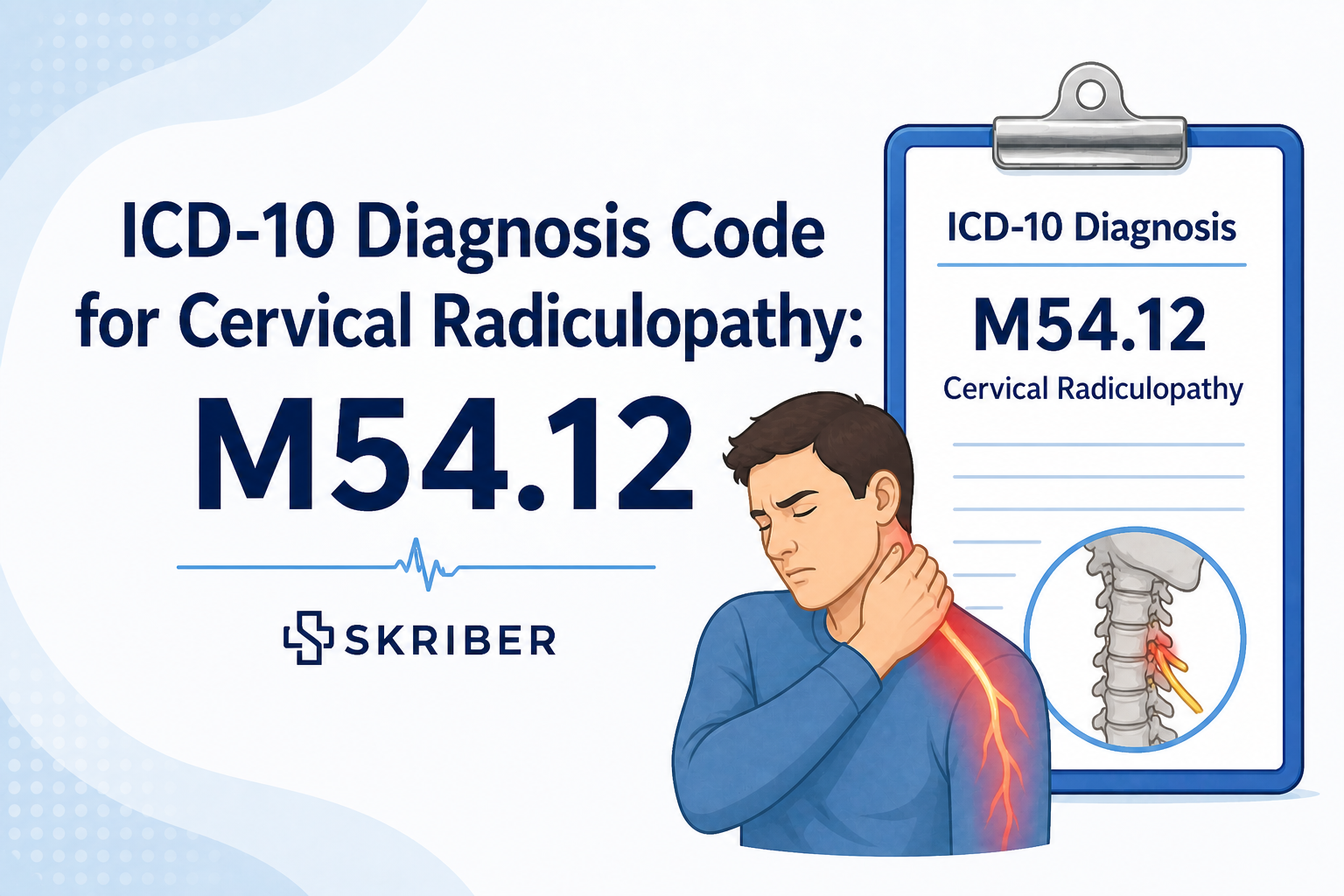
Today, we will focus on code M54.12. This code stands for “Cervical Radiculopathy.” We will break down what it means, when to use it, and what to avoid. By the end, you will feel confident using this code for your patients.
What Does M54.12 Actually Mean?
The Breakdown of the Code
ICD-10 codes are alphanumeric. Each character gives specific information. Let us look at M54.12 piece by piece.
- M = This means the condition falls under “Diseases of the Musculoskeletal System and Connective Tissue.”
- 54 = This points to “Dorsalgia.” Dorsalgia is a medical word for back pain. In this case, it includes the neck area (cervical spine).
- .1 = This specifies “Radiculopathy.” Radiculopathy happens when a nerve root in the spine is pinched or irritated.
- 2 = This is the location. It stands for the “Cervical” region (the neck).
So, M54.12 literally means: Musculoskeletal disease → Dorsalgia → Radiculopathy → Cervical region.
Cervical Radiculopathy in Plain Words
Think of the spine as a stack of bones (vertebrae). Between each bone, nerves branch out like tree roots. These are nerve roots. When something presses on a nerve root in your neck, that is cervical radiculopathy.
The pressure causes pain, but not just in the neck. The pain travels down the nerve path. So a patient may have a pinched nerve at C6, but feel pain in their thumb and index finger. This is called radicular pain.
Remember, M54.12 is for radiculopathy without a known specific cause like a tumor or fracture. Use this code when the nerve problem is the main issue.
When to Use M54.12 vs. Other Codes
The Classic Symptoms That Fit This Code
Your patient’s story matters most for coding. Here are the typical symptoms that support using M54.12.
- Pain that starts in the neck and shoots down one arm. The pain is often sharp or burning.
- Numbness or tingling in a specific pattern. For example, the thumb and index finger (C6) or the middle finger (C7).
- Weakness in the arm, shoulder, or hand muscles. The patient may drop things or have trouble lifting objects.
- Reduced reflex. For example, a diminished biceps reflex (C5-C6) or triceps reflex (C7).
If your patient has these symptoms without a clear injury or disease, M54.12 is a strong first choice.
What M54.12 is NOT For
Many providers use M54.12 incorrectly. Avoid these common mistakes.
| Do NOT Use M54.12 For | Instead, Use This Code |
|---|---|
| Simple neck muscle strain without arm symptoms | M54.2 (Cervicalgia) |
| Known disc herniation causing the nerve problem | M50.1 – M50.13 |
| Cervical spinal stenosis | M48.02 |
| Pain after a car accident (whiplash) | S13.4XXA (Sprain of neck) |
| Arthritis causing nerve compression | M47.22 (Cervical spondylosis with radiculopathy) |
The key difference is known cause. If you see a clear disc herniation on MRI, do not use M54.12. Use the disc code (M50 series). M54.12 is for radiculopathy when the cause is not specified or not yet known.
How to Document for M54.12 Correctly
Three Things Your Note Must Have
Insurance companies and auditors love to deny M54.12. Why? Because it is a “non-specific” code. To get paid, your documentation needs to prove the diagnosis. Here is a simple checklist.
- Location: State clearly that the radiculopathy is in the cervical spine. Write “cervical radiculopathy” in your assessment line.
- Side: M54.12 does not specify left or right. But you should still document the side in your note. Use a separate code for laterality if needed (like M54.12 for unspecified side, or add a laterality code if the system requires it).
- Exam findings: Document positive Spurling’s test, reduced reflexes, or myotomal weakness. For example: “Patient has decreased sensation along the C6 distribution of the right arm.”
Without these three things, your code is weak. A auditor may say, “This is just neck pain.” And downgrade it to M54.2 (Cervicalgia), which pays less.
Example of a Good Assessment Note
“The patient presents with a 4-week history of neck pain radiating to the left shoulder and down to the thumb and index finger. Exam shows positive Spurling’s test on the left. Left biceps reflex is 1+ (normal is 2+). Sensation is reduced over the left thumb. Diagnosis: Left-sided cervical radiculopathy, likely C6 level. ICD-10 code M54.12.”
This note is clear. It mentions location (cervical), side (left), exam findings (Spurling’s, reflex, sensation), and the suspected nerve level. This will survive an audit.
Common Causes of Cervical Radiculopathy You Should Know
Age-Related Wear and Tear
As patients get older, their spines change. Discs lose water and become shorter. Bone spurs (osteophytes) grow. These changes can narrow the holes where nerve roots exit. This is called foraminal stenosis.
In older adults, radiculopathy often comes on slowly. There may be no injury. The patient just wakes up one day with arm pain. M54.12 works well here if you have not done an MRI yet. But if an MRI shows severe foraminal stenosis, you may need to use M48.02 (Cervical spinal stenosis) instead.
Disc Problems in Younger Adults
Younger patients (ages 30-50) often get radiculopathy from a herniated disc. The soft center of the disc pushes out. It touches the nerve root. This usually happens after lifting something heavy or a sudden twist.
For these patients, do not use M54.12 if you have imaging proof. Use M50.12 (Cervical disc disorder at C5-C6 with radiculopathy) or M50.13 (C6-C7 level). These codes are more specific and tell a better story. Save M54.12 for when imaging is not done or is inconclusive.
A Quick Reference Table for Cervical Nerve Roots
Knowing which nerve root is affected helps you document better. It also supports using M54.12 correctly. Here is a simple table.
AI-Powered • HIPAA-Ready
Let AI handle your clinical notes.
Skriber listens during the visit and creates complete SOAP notes in seconds — so you can stay focused on the patient.
-
Capture Ambient listening during sessions
-
Transcribe Speech → text instantly
-
Generate SOAP Accurate structured notes
-
Review & sign Edit and finalize instantly
| Nerve Root | Pain/Numbness Area | Weakness | Reflex Change |
|---|---|---|---|
| C5 | Shoulder and upper arm | Shoulder abduction (lifting arm to side) | None reliable |
| C6 | Thumb and index finger | Wrist extension (bending wrist backward) | Biceps reflex reduced |
| C7 | Middle finger | Elbow extension (straightening elbow) | Triceps reflex reduced |
| C8 | Ring and small finger | Finger flexion (making a fist) | None reliable |
Use this table in your exam. If your patient has thumb numbness, write “C6 radiculopathy” in your note. This level of detail makes M54.12 much stronger.
How M54.12 Compares to Similar Codes
M54.12 vs. M54.11 and M54.13
The code M54.1 is the parent code for “Radiculopathy.” The last digit tells you the location.
- M54.11 = Radiculopathy, Occipital region (back of the head and upper neck).
- M54.12 = Radiculopathy, Cervical region (mid-neck down to shoulders).
- M54.13 = Radiculopathy, Cervicothoracic region (lower neck and upper back).
Do not confuse these. If the pain stops at the shoulder and does not go down the arm, it may be M54.11 (occipital neuralgia). If it goes down past the elbow to the fingers, M54.12 is better. If the pain also involves the upper back between the shoulder blades, consider M54.13.
M54.12 vs. G54.2 (Cervical Root Disorder)
This is a tricky one. G54.2 is “Cervical root disorders, not elsewhere classified.” It falls under nervous system diseases, not musculoskeletal.
When do you use G54.2? Use it for true nerve root lesions from things like shingles (herpes zoster), tumors, or radiation damage. For most mechanical pinched nerves from discs or arthritis, M54.12 is the correct musculoskeletal code. If you are unsure, ask your coder. But in general, for routine spine patients, stick with M54.12.
Step-by-Step: How to Pick the Right Code for Your Patient
A Simple Decision Flowchart in Words
Follow these steps when you see a patient with neck and arm pain.
- Does the patient have arm symptoms? (Pain, numbness, weakness in the arm or hand)
- No → Use M54.2 (Cervicalgia).
- Yes → Go to step 2.
- Do you have an MRI showing a specific cause? (Disc herniation, severe stenosis, tumor)
- Yes (Disc) → Use M50.1_ (with the correct level).
- Yes (Stenosis) → Use M48.02.
- Yes (Other) → Use that specific code.
- No MRI or MRI not done → Go to step 3.
- Is the patient’s exam consistent with a nerve root problem? (Positive Spurling’s, dermatomal sensory loss, myotomal weakness)
- No → Use M54.2.
- Yes → Use M54.12.
This flowchart works for most outpatient visits. It keeps you out of trouble.
What to Do After You Pick M54.12
Once you choose M54.12, your work is not done. You need a plan. Document the next steps.
- Plan for conservative care: “Will start physical therapy and a 7-day course of NSAIDs.”
- Plan for imaging: “If no improvement in 4 weeks, will order MRI cervical spine without contrast.”
- Plan for referral: “Will refer to physical medicine and rehab for further management.”
A good plan shows medical necessity. It tells the insurance company, “This patient needs treatment, and we are following guidelines.” This reduces denials.
The Most Common Billing Mistakes for M54.12
Mistake #1: Using M54.12 with a Disc Code
Some providers list both M54.12 and M50.12 on the same claim. Do not do this. The disc code (M50.12) is more specific. It includes the radiculopathy. Using both is “double dipping.” The insurance will deny one of them.
Rule: Pick the most specific code you have. If you know the disc level, use M50.12. If you only know it is cervical radiculopathy without a level, use M54.12. Never use both for the same encounter.
Mistake #2: Forgetting the Seventh Character for Injuries
If your patient has radiculopathy from an acute injury (like a fall or car crash), do not use M54.12. Use the injury code (S series). For example, S14.2XXA for injury of nerve root of cervical spine.
M54.12 is for non-traumatic radiculopathy. Using it for a trauma case is incorrect. The insurance will deny it, and you could face an audit for upcoding.
Mistake #3: Not Documenting Laterality When Required
M54.12 does not have a built-in way to show left versus right. Some payers do not care. Others will deny if you do not specify the side. To be safe, always document the side in your note. In some systems, you can add a separate code for laterality (like G89.29 for pain on the left, though this is not always needed). Check with your billing department.
Real Clinical Scenarios: Apply Your Knowledge
Scenario 1: The Office Worker
A 45-year-old accountant has right neck pain for 3 months. She has tingling in her right thumb and index finger. Spurling’s test is positive on the right. MRI shows mild C5-C6 disc bulge without herniation. The radiologist says “no definite nerve compression.”
Your code: M54.12 (Cervical radiculopathy). The MRI does not show a clear disc herniation. The symptoms and exam point to nerve irritation. This is a perfect use of M54.12.
Scenario 2: The Construction Worker
A 35-year-old man lifted a heavy beam yesterday. Now he has severe left arm pain, numbness in the middle finger, and weak triceps. MRI shows a large C6-C7 disc herniation compressing the C7 nerve root.
Your code: M50.13 (Cervical disc disorder at C6-C7 with radiculopathy). Do not use M54.12 here. You have a clear cause (disc herniation) and a specific level. Use the specific code.
Scenario 3: The Retired Teacher
A 70-year-old woman has neck pain and numbness in both hands for years. There is no arm weakness. MRI shows severe spinal stenosis from C4 to C7.
Your code: M48.02 (Cervical spinal stenosis). This is not radiculopathy alone. This is myelopathy or stenosis. M54.12 would be incorrect because the main problem is the narrow canal, not just a single nerve root.
Final Summary and Key Takeaways
Quick Facts to Remember
- M54.12 is for cervical radiculopathy without a specified cause.
- Use it when symptoms (pain, numbness, weakness) follow a nerve root pattern in the arm.
- Always document a positive exam finding (Spurling’s, reflex loss, dermatomal change).
- Do not use M54.12 if you have an MRI showing disc herniation or severe stenosis.
- Avoid using M54.12 with more specific codes like M50.12 on the same claim.
A Final Word for Your Practice
Coding is a skill. It takes practice, just like performing a physical exam. M54.12 is a useful code, but it is not the final answer. Think of it as a starting point. As you gather more information (imaging, response to treatment), you may need to change the code.
Document as if an auditor will read your note tomorrow. Be clear. Be specific. Describe the nerve root pattern. Your future self (and your billing team) will thank you. Keep learning, keep asking questions, and always put the patient’s story first. The right code will follow.
for clinicians · HIPAA-ready
Spend more time with patients, not paperwork.
Skriber transforms ambient speech into accurate SOAP notes — finished before your next session.
No credit card required.


Dr. Connor Yost is an Internal Medicine resident at Creighton University School of Medicine in Arizona and an emerging leader in clinical innovation. He currently serves as Chief Medical Officer at Skriber, where he helps shape AI-powered tools that streamline clinical documentation and support physicians in delivering higher-quality care. Dr. Yost also works as a Strategic Advisor at Doc2Doc, lending his expertise to initiatives that improve financial wellness for physicians and trainees.
His professional interests include medical education, workflow redesign, and the responsible use of AI in healthcare. Dr. Yost is committed to building systems that allow clinicians to spend more time with patients and less on administrative tasks. Outside of medicine, he enjoys photography, entrepreneurship, and family life.