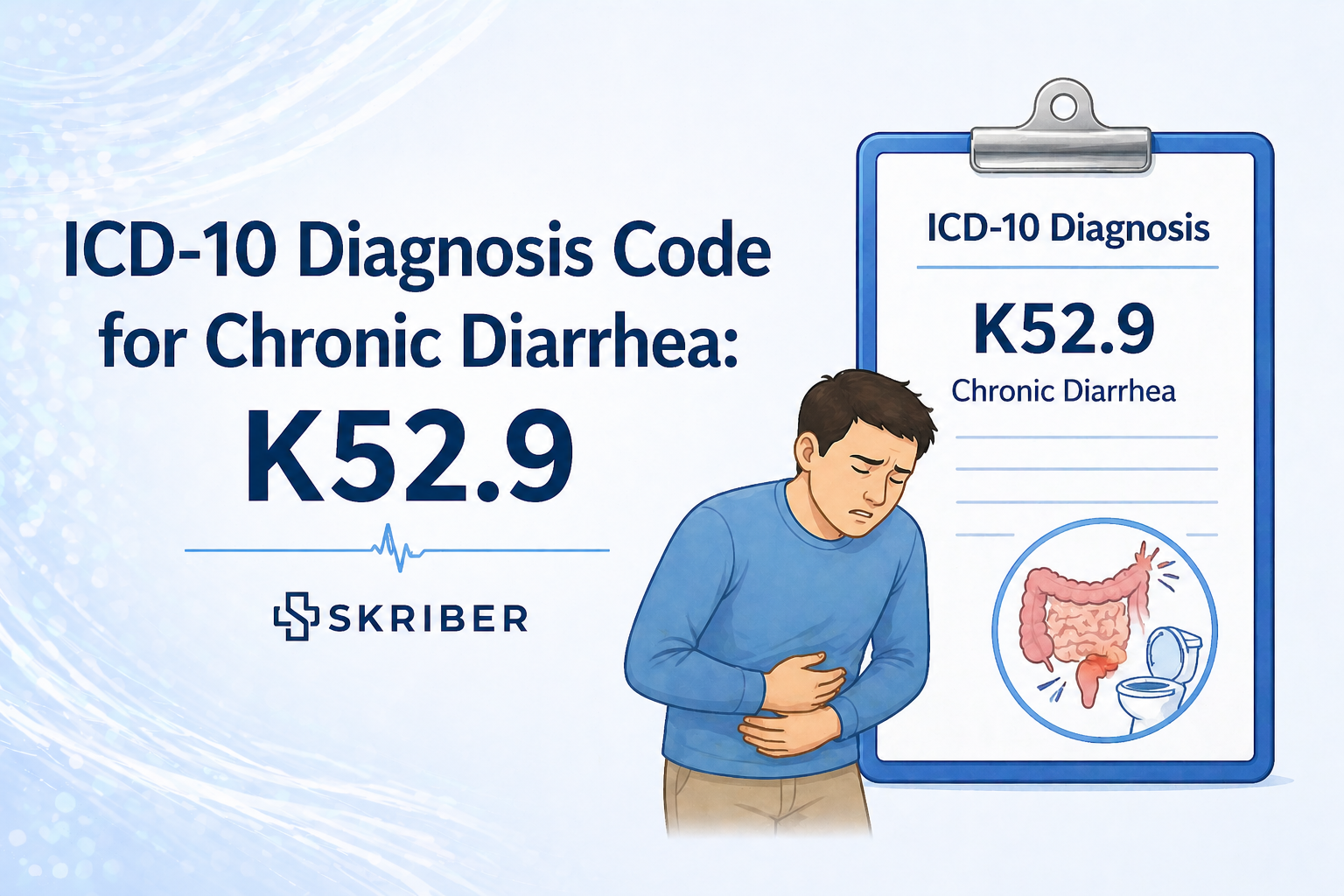
For medical coders, gastroenterologists, and primary care providers, few ICD-10 codes appear as frequently, or cause as much confusion, as K52.9. Officially labeled “Noninfective Gastroenteritis and Colitis, Unspecified,” this code describes a patient with chronic gut inflammation of unknown origin. It’s a necessary placeholder when tests have ruled out infection but a specific diagnosis (like Crohn’s, microscopic colitis, or celiac disease) remains elusive. However, using K52.9 correctly requires more than just checking a box. In this blog, we’ll clarify exactly when to apply K52.9, when to avoid it, and how to document effectively to support accurate coding, smoother insurance claims, and better patient outcomes. Let’s turn this often-misunderstood code into a clear, practical tool for your daily practice.
What Does K52.9 Really Mean?
K52.9 is a catch-all code. It is used for chronic diarrhea that is not caused by a known infection. The gut is inflamed. The patient has symptoms like loose stools, belly pain, or urgency to use the bathroom. But tests have not found a specific disease name.
Think of K52.9 as a “placeholder” code. It tells the insurance company: “This patient has a real problem. We just do not have the final diagnosis yet.” For example, a patient may have chronic diarrhea for six weeks. All stool tests are negative. The colon looks normal. You do not know if it is Crohn’s or colitis. So you use K52.9.
This code is very common in hospital charts. But it is also a “last resort” code. Good doctors try to move away from K52.9 to a more specific code. Specific codes help with treatment plans and research.
Why This Code Matters for Chronic Diarrhea
Chronic diarrhea means loose stools for four weeks or longer. This is different from acute diarrhea, which lasts only a few days. Chronic diarrhea has many possible causes. Some causes are easy to treat. Others are serious diseases.
Using K52.9 tells the medical team that the patient needs more tests. It is a signal. It says: “We are not done looking for answers.” For example, a patient with chronic diarrhea may have microscopic colitis. That is a type of inflammation only seen under a microscope. Until you do a biopsy, K52.9 is correct. But using this code for too long is not good. It can delay proper treatment. It can also make it harder to get insurance approval for expensive drugs. So use K52.9 as a temporary tool. Always work toward a final, specific diagnosis.
Common Causes of Chronic Diarrhea (When K52.9 Might Apply)
Before we talk more about the code, let us review what causes chronic diarrhea. Knowing this helps you know when K52.9 is truly needed. Here are the most common causes:
- Irritable Bowel Syndrome (IBS). This is very common. The gut works poorly, but there is no inflammation. Technically, K52.9 is for inflammation. So IBS is not a perfect fit. But many coders use K52.9 for IBS with diarrhea. This is a gray area. Better codes exist for IBS (K58.0 for IBS with diarrhea).
- Microscopic Colitis. This is inflammation you can only see with a biopsy. The colon looks normal during a scope. But under the microscope, there is damage. This is a perfect use of K52.9 before the biopsy result comes back. Once confirmed, you use K52.82 or K52.83.
- Celiac Disease. This is an immune reaction to gluten. It damages the small intestine. Before the blood test confirms celiac, K52.9 may be used. After diagnosis, you use K90.0 (Celiac disease).
- Medication Side Effects. Some drugs cause chronic diarrhea. Common ones are antibiotics, blood pressure pills, and diabetes drugs. If the patient has diarrhea but no infection or disease, K52.9 fits.
- Bile Acid Diarrhea. The body makes too much bile. The bile irritates the colon. This is common after gallbladder surgery. Many doctors do not test for it. So K52.9 is often used here.
As you can see, K52.9 is like a “mystery box.” It covers many possible causes. Your job is to open the box and find the real answer.
When to Use K52.9 (The Right Way)
Let us be very clear about the correct use of K52.9. You should use this code when all three of these things are true:
First, the diarrhea is chronic. That means four weeks or longer. Do not use K52.9 for a three-day stomach bug. For short-term diarrhea with no infection, use K52.89 (other specified noninfective gastroenteritis) or even R19.7 (diarrhea, unspecified). Second, tests have ruled out infection. You must check stool samples for bacteria, parasites, and viruses. If you find an infection like C. diff or Giardia, use the infection code (like A04.7 for C. diff). Do not use K52.9. Third, you do not have a specific noninfective diagnosis yet. For example, you suspect Crohn’s disease. But the MRI and colonoscopy are next week. Until those tests are done, K52.9 is fine. Once you see the ulcers and skip lesions of Crohn’s, you switch to K50.00.
Here is a good rule: Use K52.9 for the first visit or two. After that, if you still have no answer, ask yourself why. Maybe you need more tests. Or maybe you need a specialist.
When NOT to Use K52.9 (Common Mistakes)
Many healthcare pros use K52.9 too often. This can cause problems. Let us look at when you should avoid this code.
Do not use K52.9 for known infections. We said this before, but it is worth repeating. If the stool culture is positive for Salmonella, you must use the Salmonella code (A02.0). Using K52.9 for an infection is wrong. It affects public health data and insurance claims.
Do not use K52.9 for acute, short-term diarrhea. If a patient has loose stools for two days after eating bad food, that is not chronic. That is acute. Use R19.7 (diarrhea, unspecified) for that. Or use K52.9 only if you know there is inflammation and it is not an infection. But R19.7 is usually better for acute cases.
Do not us1.00e K52.9 when a more specific code exists. For example, if the patient has known ulcerative colitis, use K5 If they have IBS with diarrhea, use K58.0. If they have chronic pancreatitis, use K86.1. Specific codes tell a better story. They help other doctors understand the patient’s real problem.
Do not use K52.9 for functional diarrhea. Functional diarrhea is a separate condition. It means the gut works strangely but there is no inflammation. The proper code is K59.1. Mixing up K52.9 (inflammation) and K59.1 (no inflammation) is a common billing error.
How to Document for K52.9
Good documentation protects you, your patient, and your hospital. When you use K52.9, your notes need to be very clear. Here is what to write in the patient’s chart:
Write down the timeline. How long has the patient had diarrhea? Six weeks? Six months? Write the exact start date if you know it. Example: “Patient reports loose, watery stools 4-6 times per day for 8 weeks.”
Write down what tests you have done. List all negative stool studies. List pending biopsies. List upcoming scopes. This shows you are working toward a diagnosis. Example: “Stool culture, O&P, and C. diff PCR all negative. Awaiting colonoscopy with biopsies.”
Write down symptoms you have ruled out. Did the patient have blood in the stool? Fever? Weight loss? If these are absent, write that down. If they are present, that points to a more serious disease. Example: “No hematochezia. No fever. No unintentional weight loss.”
AI-Powered • HIPAA-Ready
Let AI handle your clinical notes.
Skriber listens during the visit and creates complete Progress notes in seconds — so you can stay focused on the patient.
-
Capture Ambient listening during sessions
-
Transcribe Speech → text instantly
-
Generate Notes Accurate structured notes
-
Review & sign Edit and finalize instantly
Write down your differential diagnosis. A differential diagnosis is a list of possible causes. Write, “Possible causes include microscopic colitis, bile acid diarrhea, or Crohn’s disease limited to small bowel.” This shows medical necessity for using K52.9.
Do not write vague notes. Avoid notes that say only “chronic diarrhea.” That is not enough. The coder and the insurance company need details. A vague note leads to a denied claim.
The Risks of Using K52.9 Long-Term
K52.9 has its place. But leaving a patient with this code for months or years is a problem. Let us talk about why.
Risk one: Delayed treatment. Without a specific diagnosis, you cannot give specific treatment. For example, if the patient actually has microscopic colitis, they need steroids like budesonide. But if you only have K52.9, you might not try that drug. The patient stays sick longer.
Risk two: Insurance denials. Insurance companies want to see a clear diagnosis. If you keep using K52.9, they may deny payment for expensive tests or drugs. They will ask: “Why are you not doing more to find the real cause?” This is frustrating for you and your patient.
Risk three: Poor quality data. Public health researchers look at ICD-10 codes. If too many people use K52.9, the data says “many people have unknown gut inflammation.” That is not helpful. Specific codes help researchers find trends, causes, and better treatments.
Risk four: Medical errors. If one doctor sees K52.9 in the chart, they may think the cause is still unknown. But maybe a previous doctor already found the cause and forgot to update the code. This leads to repeat tests and wasted time.
The safest plan is to review the diagnosis every 30 to 90 days. Ask yourself: “Do we still not know the cause? Or can we finally give a specific code?”
Other ICD-10 Codes Similar to K52.9
Sometimes you need a code close to K52.9 but not exactly the same. Here are the most similar codes and when to use them.
K52.82
Eosinophilic colitis. Use this when a biopsy shows many eosinophils (a type of white blood cell). This is a specific type of inflammation. It is not the same as unspecified colitis.
K52.83
Microscopic colitis. Use this after biopsy confirms the diagnosis. This code has two subtypes (lymphocytic and collagenous), but K52.83 covers both. It is much better than K52.9.
K52.89
Other specified noninfective gastroenteritis and colitis. Use this for rare, named conditions. For example, if a patient has drug-induced colitis from a chemotherapy drug, K52.89 works.
K52.9
Noninfective gastroenteritis and colitis, unspecified. This is our main code. Use it only when you have ruled out infection and you cannot specify the type of noninfective inflammation.
R19.7
Diarrhea, unspecified. Use this for acute diarrhea or for chronic diarrhea with no signs of inflammation. If the patient has no belly pain, no fever, and normal blood work, R19.7 may be better than K52.9.
K59.1
Functional diarrhea. Use this for chronic diarrhea with no inflammation AND no other gut motility problems. This is different from IBS. It is just frequent loose stools with a normal gut.
Memorizing these five codes will make you a better coder and a better clinician.
Guide to Choosing K52.9
Let us walk through a real patient case. This will show you exactly how to decide on K52.9.
- Listen to the patient. Mrs. Jones is 55 years old. She has had watery diarrhea for 10 weeks. She goes to the bathroom 5 to 6 times per day. She has mild cramping but no blood. She has not lost weight.
- Order initial tests. You order a stool culture, O&P, C. diff toxin, and a CBC. All come back normal. The CBC shows no signs of infection or inflammation. Her CRP and ESR (inflammation markers) are normal.
- Ask more questions. Mrs. Jones had her gallbladder removed five years ago. She takes metformin for diabetes. Both of these can cause chronic diarrhea. You stop the metformin for one week. No change. So that is not the cause.
- Decide on the code. You do not see inflammation on blood tests. But you have not done a colonoscopy yet. You cannot rule out microscopic colitis or Crohn’s. So at this point, K52.9 is reasonable. But you also add a note: “Suspected bile acid diarrhea or microscopic colitis. Colonoscopy scheduled.”
- Follow up. Mrs. Jones gets a colonoscopy. The colon looks normal to the naked eye. But biopsies show collagenous colitis, a type of microscopic colitis. Now you change the code to K52.83. You stop using K52.9 permanently.
See how K52.9 was just a bridge? It got Mrs. Jones to the right tests. And then you moved to the correct code. That is the perfect use of K52.9.
Final Thoughts and Key Takeaways
K52.9 is a helpful but limited code. It tells the medical world: “This patient has unexplained chronic gut inflammation.” It is not a final answer. It is a starting point. As healthcare professionals, we owe it to our patients to move past K52.9. Every time you use this code, ask yourself: “What is the next test? When will I have a real diagnosis?” Keep asking those questions. Keep digging.
Remember these three big ideas:
- Use K52.9 only after you rule out infection.
- Do not use K52.9 for more than a few months without a plan.
- Always document your thinking so the coder and other doctors understand.
Chronic diarrhea is hard on patients. They are tired. They are frustrated. They want answers. By using K52.9 the right way, you give them a path forward. You say, “I do not know the answer yet, but I will find it.” That is what good healthcare looks like. Thank you for reading. Now go take a look at your charts. Do you have any patients still sitting with K52.9 from six months ago? If yes, it is time to revisit their case. You might just find the answer you missed before.
Frequently Asked Questions
Can I Use K52.9 for Children?
Yes, you can use K52.9 for children with chronic diarrhea. But be extra careful. Children have different causes of chronic diarrhea compared to adults. Think about conditions like toddler’s diarrhea, congenital diarrheal disorders, and food protein-induced enterocolitis syndrome (FPIES). Also consider cystic fibrosis, which causes diarrhea from malabsorption.
The same rules apply: rule out infection, look for specific noninfective causes, and use K52.9 only when nothing fits. For infants with chronic diarrhea, do not forget to check for metabolic disorders and immune deficiencies. These are rare but serious.
Does K52.9 Require a Modifier?
Usually not. K52.9 is a complete code on its own. You do not need additional characters. But you may need to add a code for symptoms like dehydration (E86.0) or malnutrition (E44.0). If the patient has both chronic diarrhea and another condition, list the primary diagnosis first. If the diarrhea is the main reason for the visit, K52.9 can be the primary code. If something else is more important, like anemia or weight loss, then K52.9 can be a secondary code.
Always check with your billing and coding team. Rules change, and different payers have different requirements. Some insurance companies want you to use K59.1 for chronic diarrhea without inflammation, not K52.9. Know your local policies.
for clinicians · HIPAA-ready
Spend more time with patients, not paperwork.
Skriber transforms ambient speech into accurate Progress notes — finished before your next session.
No credit card required.


Dr. Connor Yost is an Internal Medicine resident at Creighton University School of Medicine in Arizona and an emerging leader in clinical innovation. He currently serves as Chief Medical Officer at Skriber, where he helps shape AI-powered tools that streamline clinical documentation and support physicians in delivering higher-quality care. Dr. Yost also works as a Strategic Advisor at Doc2Doc, lending his expertise to initiatives that improve financial wellness for physicians and trainees.
His professional interests include medical education, workflow redesign, and the responsible use of AI in healthcare. Dr. Yost is committed to building systems that allow clinicians to spend more time with patients and less on administrative tasks. Outside of medicine, he enjoys photography, entrepreneurship, and family life.