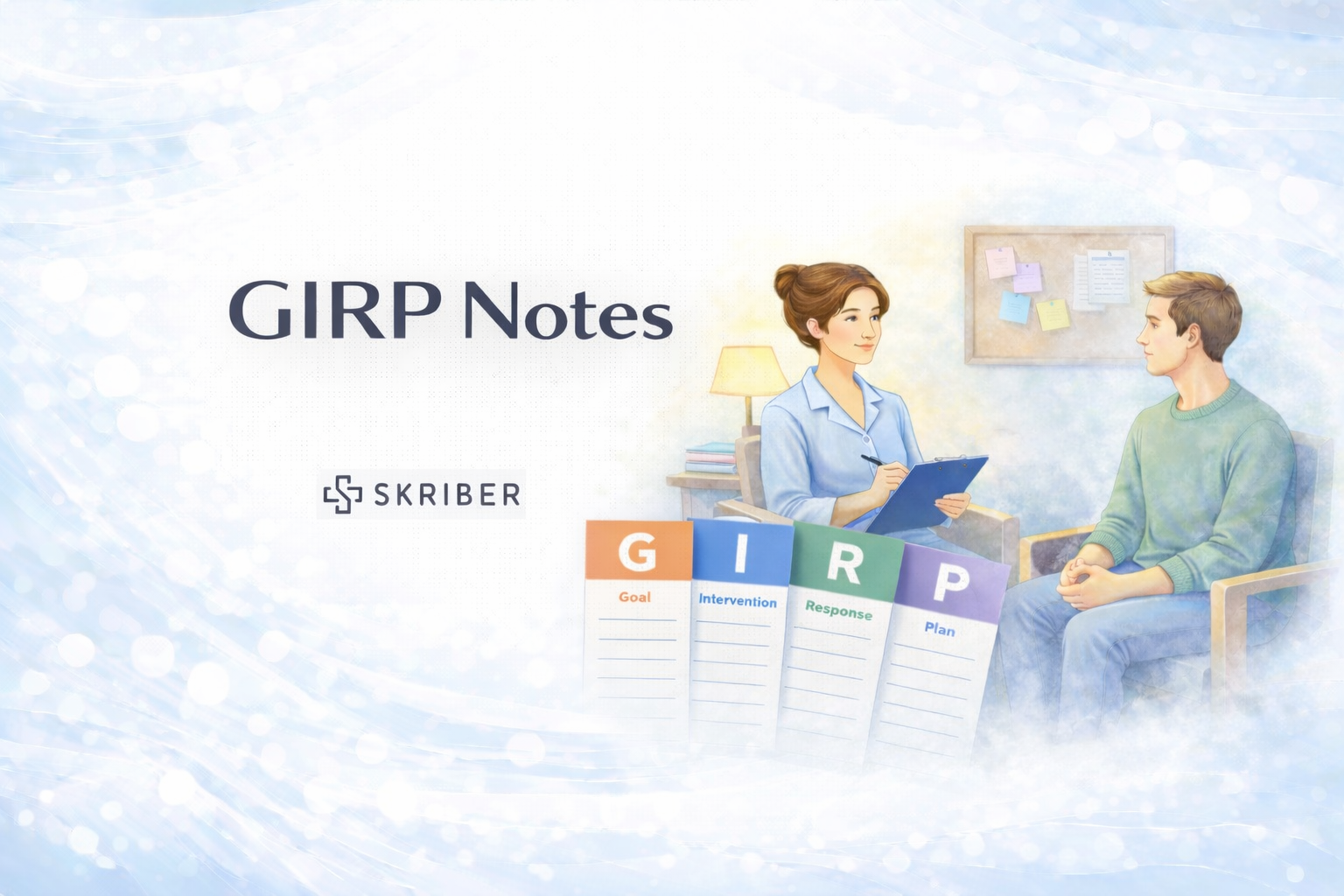
Writing notes during or after a therapy session can feel like a lot of work. We spend our days connecting with people, listening to their deepest struggles, and helping them find a path forward. Then, when the session is over, we have to sit down and write it all down. It can be tempting to just write a few quick sentences to get it done. But quality notes are important. They help us remember what we talked about. They show the progress our clients are making. They protect us if there are ever questions about our work. And most importantly, they help the next person who works with this client understand what they need. One of the best ways to write these notes is by using a simple structure called GIRP. GIRP stands for Goal, Intervention, Response, and Plan. Think of GIRP as a simple formula. If you follow the steps, you will end up with a clear, helpful note every time.
In this blog we will walk you through each part of GIRP, using examples, so you can write notes that are both easy and professional.
What is GIRP? Why Use It?
Before we break down each letter, let us talk about what GIRP is. It is a format for writing progress notes. Many clinicians use it because it is simple and organized. It tells a short story of the session.
- Goal: What are we working on?
- Intervention: What did you, the clinician, actually do?
- Response: How did the client react?
- Plan: What happens next?
Using GIRP makes sure you do not forget important parts. It helps you move from a messy paragraph to a clear, step-by-step note. It also keeps your notes focused on the client’s treatment plan. If you have ever looked back at an old note and thought, “What was I doing with this person?” then GIRP is for you.
Let us start at the very beginning: The Goal.
G: Goal – What Are We Working On?
The first part of your note is the Goal. This is where you connect the session back to the client’s main reason for coming to therapy. Every client has a treatment plan. This plan has goals. Your note’s goal section should briefly state which goal you worked on during this session.
You do not need to write the entire goal from the treatment plan. Just give a short summary. This helps anyone reading the note understand the purpose of the session. It answers the question, “Why did this session happen?”
Think of the Goal as your anchor. It keeps the rest of your note tied to the client’s long-term progress. If you are working on a goal about anxiety, your intervention and the client’s response should all connect back to that.
Example of a Goal Statement
Here are a few simple ways to write the Goal section.
Example 1: Working on Anxiety
The session focused on the client’s treatment plan goal to reduce symptoms of social anxiety and increase participation in social activities.
Example 2: Working on Grief
The session addressed the client’s goal to process feelings of grief related to the recent loss of their spouse and develop healthy coping skills.
Example 3: Working on a Teenager’s Behavior
The session focused on the client’s treatment plan goal to improve communication with parents and decrease verbal arguments at home.
See how simple that is? You are just stating the “what” of the session. Keep it short. Keep it clear. Now, let us move to the most important part: what you did.
I: Intervention – What Did You Do?
The Intervention section is about you, the clinician. This is where you write down the specific tools, techniques, and methods you used during the session. This is the heart of your note because it shows your work. It shows that you were not just chatting, but actively using your skills to help.
You want to be specific here. Do not just say, “We talked.” Instead, say what kind of talking you did. Did you use Cognitive Behavioral Therapy (CBT)? Did you teach a deep breathing exercise? Did you use a worksheet? Did you practice a new skill? Did you provide a safe space for them to cry?
Think of this as your “action” list. Use active words like “explored,” “processed,” “taught,” “practiced,” “reflected,” “challenged,” “supported,” and “validated.” These words show exactly what you did.
Examples of Intervention Statements
Let us look at some examples based on the goals we used above.
AI-Powered • HIPAA-Ready
Let AI handle your clinical notes.
Skriber listens during the visit and creates complete Progress notes in seconds — so you can stay focused on the patient.
-
Capture Ambient listening during sessions
-
Transcribe Speech → text instantly
-
Generate Notes Accurate structured notes
-
Review & sign Edit and finalize instantly
Example 1: Intervention for Anxiety
The clinician introduced the concept of the “anxiety cycle,” showing the client how thoughts, feelings, and behaviors are connected. The clinician then guided the client through a 5-minute diaphragmatic breathing exercise. The clinician provided psychoeducation on how this breathing technique can calm the nervous system.
- Why this is good: It names a specific CBT concept (anxiety cycle), names a specific skill (diaphragmatic breathing), and uses the word “guided,” which shows active involvement.
Example 2: Intervention for Grief
The clinician used a person-centered approach, providing a non-judgmental space for the client to share memories of their spouse. The clinician utilized reflective listening to validate the client’s feelings of sadness and anger. The clinician introduced the concept of “continuing bonds,” discussing ways the client can maintain a connection to their loved one while moving forward.
- Why this is good: It shows the approach (person-centered), the specific skill (reflective listening), and a therapeutic concept (continuing bonds). It shows the clinician was both supportive and active.
Example 3: Intervention for a Teenager
The clinician facilitated a conversation between the client and their parent using a structured communication exercise. Each person was given three minutes to speak without interruption. The clinician then helped them identify one specific request for change from each person.
- Why this is good: It describes a specific intervention (structured communication exercise) and shows the clinician’s role as a “facilitator” who helps guide the interaction.
Your intervention section should show your clinical thinking. It shows you had a plan. Now, the next section shows how the client responded to your plan.
Response – How Did the Client React?
The Response section is about the client. This is where you describe what you saw and heard from them during the session. It answers the question, “What happened when I did the intervention?”
This part is very important. It shows if your intervention was helpful. Did the client seem engaged? Did they learn the skill? Did they get emotional? Did they disagree? Their response tells you and other clinicians what is working and what is not.
Try to be objective here. Write what you observed. Use words like “client stated,” “client reported,” “client demonstrated,” or “client appeared.” You are not judging them. You are just describing their reaction.
Examples of Response Statements
Let us continue with our three examples to see how the client’s response connects to the intervention.
Example 1: Response for Anxiety
The client was engaged and able to identify her own “anxiety cycle.” She stated, “I see how my thoughts make the panic worse.” She was able to follow the breathing exercise and reported her heart rate slowed down from a 7 to a 3 on a scale of 1 to 10. She stated she felt “more in control.”
- Why this is good: It shows engagement, quotes the client’s own words, and gives a specific measure (heart rate from 7 to 3) to show the skill worked.
Example 2: Response for Grief
The client cried for several minutes while sharing memories. He was able to name feelings of both sadness and anger. When discussing “continuing bonds,” the client’s affect softened, and he reported feeling a sense of relief. He stated, “I thought I had to say goodbye forever, but I don’t.”
- Why this is good: It describes the emotional response (crying, affect softened), shows the client’s level of insight, and uses a direct quote to show a shift in thinking.
Example 3: Response for a Teenager
The client remained quiet during the first two minutes of his speaking turn but then became more expressive, stating he felt “ignored” at home. The parent reported feeling “surprised” by this. Both parties agreed to the one specific request for change: to have a 10-minute check-in after school each day.
- Why this is good: It gives a moment-by-moment observation (quiet, then expressive), shows the client’s and parent’s reactions, and shows a concrete agreement was made.
The Response section connects directly to the Intervention. The intervention was a structured exercise, and the response was a quiet teen who opened up. This tells a clear story. Now, we need to decide what to do next.
P: Plan – What Happens Next?
The Plan is the final part of your note. It answers the question, “Where do we go from here?” This section is forward-looking. It shows the next steps for the client, for you, and for the treatment.
Your plan should be clear and simple. It can include the date and time of the next session. It can include tasks for the client to do between sessions (we call this “homework”). It can also include things you, the clinician, will do, like consult with a psychiatrist or reach out to a family member.
A good plan keeps the therapy moving forward. It shows continuity of care. If another clinician reads this note, they should know exactly what is supposed to happen next.
Examples of Plan Statements
Let us finish our three examples with a clear plan.
Example 1: Plan for Anxiety
The client and clinician agreed to meet next Tuesday at 2:00 PM. The client will practice the diaphragmatic breathing exercise twice a day and will track her anxiety level on a provided log. The clinician will introduce cognitive restructuring techniques in the next session to help challenge negative thoughts.
- Why this is good: It states the next appointment, gives a clear homework assignment (practice breathing and track anxiety), and previews the next session’s focus.
Example 2: Plan for Grief
The next session is scheduled for Thursday at 10:00 AM. The client will bring a photo of his spouse to the next session to continue the “continuing bonds” work. The clinician will provide resources for a local grief support group per the client’s request.
- Why this is good: It sets the next meeting, gives a simple task for the client (bring a photo), and shows the clinician’s action (provide resources).
Example 3: Plan for a Teenager
The family will return for a follow-up session in one week. The client and parent will practice the 10-minute daily check-in. The clinician will continue to support communication skills and will assess the effectiveness of the check-in at the next session.
- Why this is good: It states the follow-up, gives a clear task for the family to practice, and tells what the clinician will focus on next.
The Plan section brings the note to a close. It gives direction and purpose for the future.
GIRP Note Example
Now that we have looked at each part separately, let us see what a complete GIRP note looks like. Imagine a client named Sarah who is working on anxiety. Here is her note.
Client: Sarah M.
Date: March 15, 2024
Session Number: 4
Goal:The session focused on the client’s treatment plan goal to reduce symptoms of generalized anxiety and develop skills to manage worry.
Intervention: The clinician introduced the concept of the “anxiety cycle” (thoughts, feelings, behaviors). The clinician used a whiteboard to illustrate how Sarah’s specific worry thoughts lead to physical tension and avoidance behaviors. The clinician then taught a grounding technique called “5-4-3-2-1” (identifying 5 things she sees, 4 she feels, 3 she hears, 2 she smells, and 1 she tastes). The clinician guided Sarah through this exercise. The clinician provided positive reinforcement for her engagement.
Response: Sarah was attentive and quickly grasped the anxiety cycle concept. She was able to identify her own pattern, stating, “I think ‘something bad will happen,’ then my chest gets tight, and then I cancel my plans.” She was initially hesitant to try the grounding exercise but agreed. After completing it, she reported feeling “more present” and her self-reported anxiety level decreased from an 8 to a 4. She appeared visibly more relaxed, with less muscle tension in her shoulders.
Plan: The next session is scheduled for March 22, 2024, at 1:00 PM. Sarah will practice the “5-4-3-2-1” grounding technique when she notices her anxiety rising. She will write down how she feels before and after using the skill. The clinician will introduce strategies for challenging worry thoughts in the next session.
Common Questions and Tips for Writing Better GIRP Notes
Even with a simple structure, questions can come up. Let us talk about a few common ones and some tips to make your GIRP notes even better.
How Long Should Each Section Be?
There is no set length. Some sessions are complex. Some are simple. A GIRP note can be a few sentences or a few paragraphs. The key is to be thorough but not write a novel. You want to capture the important clinical information. Think quality over quantity.
A good rule is to aim for 1 to 3 paragraphs for the entire note, with each section being a few clear sentences. If you are writing more than that for a standard session, ask yourself: “Is all this necessary?” If you are writing less, ask: “Will another clinician understand what happened here?”
What if the Client Did Not Make Progress?
This is a very important point. Your notes do not have to show progress every single time. Therapy is not a straight line. Sometimes clients have setbacks. Sometimes they are not ready to engage.
If a client did not make progress, you still write an honest note. In the Response section, you can write something like:
“The client was withdrawn and stated, ‘I don’t want to be here today.’ She declined to participate in the planned intervention and spent most of the session in silence.”
In the Plan, you can address this:
“The clinician validated the client’s feelings. The plan is to explore her ambivalence about treatment in the next session and adjust the treatment goals if needed.”
Honest notes are good notes. They show you are paying attention to the client’s real experience, not just a story of success.
Tips for Writing Simple and Clear Notes
Here are a few final tips to keep your notes simple and professional.
- Use Plain Language. You do not need to use complex clinical jargon to sound smart. Write like you talk. Instead of “The client exhibited dysphoric affect,” just write “The client looked sad.” It is clearer and faster.
- Use the Client’s Words. Putting a short, direct quote from the client in the Response section is powerful. It shows exactly what the client said and felt. It makes the note real.
- Be Objective. Describe what you saw and heard. Do not make assumptions. Instead of “The client was angry,” write “The client raised his voice, clenched his fists, and stated, ‘I am so angry.’”
- Keep it Relevant. Only include information that is connected to the treatment goal or the client’s safety. You do not need to write down every single thing they said. Focus on the clinical picture.
- Write It Soon. Try to finish your note right after the session. This is when your memory is freshest. It also prevents notes from piling up, which can make them harder to write later.
The Bottom Line: Make GIRP Your Go-To Tool
Documentation is a key part of our work as mental health clinicians. It might not be the reason we got into this field, but it is essential. It protects our clients, it protects us, and it helps us provide better care. The GIRP format, Goal, Intervention, Response, Plan—is a simple but powerful tool. It breaks down a complex session into clear, manageable parts. It tells a story. It shows your clinical skill. And it makes sure you and others can easily understand the work you are doing.
Start using GIRP for all your notes. Practice it. You will find that it becomes second nature. It will make your documentation faster, clearer, and more effective. And in the end, that gives you more time and mental energy to focus on what matters most: helping your clients heal and grow.
for clinicians · HIPAA-ready
Spend more time with patients, not paperwork.
Skriber transforms ambient speech into accurate Progress notes — finished before your next session.
No credit card required.


Dr. Connor Yost is an Internal Medicine resident at Creighton University School of Medicine in Arizona and an emerging leader in clinical innovation. He currently serves as Chief Medical Officer at Skriber, where he helps shape AI-powered tools that streamline clinical documentation and support physicians in delivering higher-quality care. Dr. Yost also works as a Strategic Advisor at Doc2Doc, lending his expertise to initiatives that improve financial wellness for physicians and trainees.
His professional interests include medical education, workflow redesign, and the responsible use of AI in healthcare. Dr. Yost is committed to building systems that allow clinicians to spend more time with patients and less on administrative tasks. Outside of medicine, he enjoys photography, entrepreneurship, and family life.